



Nasdaq Drops 2.86% in Biggest Decline Since June as Investors Sell AI Stocks; Philly Semi Falls Over 7%, Intel Plunges 28%
TradingKey - On Friday, Oct. 30, Eastern Time, U.S. stocks fell sharply as investors sold off AI-related stocks and rotated into defensive sectors such as consumer staples and healthcare. As the U.S. midterm elections approached, afternoon selling pressure intensified further, with the Nasdaq dropping significantly more than the Dow.
At the close, the Dow Jones Industrial Average fell 1.09% to 51,770.31; the Nasdaq Composite Index dropped 2.86% to 25,437.00; and the S&P 500 Index declined 1.82% to 7,580.07.
Tech Stock Performance
Amazon (AMZN) recovered from early-session losses to close down 1.41% at $240.35.
The company's third-quarter revenue and earnings both missed market expectations. Meanwhile, it disclosed negative free cash flow of $42.4 billion and maintained its 2026 capital expenditure forecast of $220 billion. According to a quarterly filing submitted by Amazon to the U.S. Securities and Exchange Commission (SEC), the company may draw on this financing facility at its discretion between early 2027 and the third quarter of 2028, with the loan collateralized by certain related purchased assets. Amazon previously relied primarily on operating cash flow and bond issuances to support data center construction and chip procurement; this further expansion of financing channels highlights the heightened demands that AI infrastructure expansion places on fundraising and cash flow management.
Intel (INTC) plunged 28.58% to $65.76.
The company issued a weak outlook for the current quarter, reflecting slowing demand in the PC market. Revenue in its Client Computing and Physical AI division fell 5% year-over-year to $8.1 billion. Intel warned that, affected by PC market weakness, it expects a net cash outflow this year, driving up credit market concerns. According to Markit data, Intel's five-year credit default swap (CDS) spread widened by 17.5 basis points to a record high of 124.75 basis points, marking what could be its largest single-day increase since October 2022.
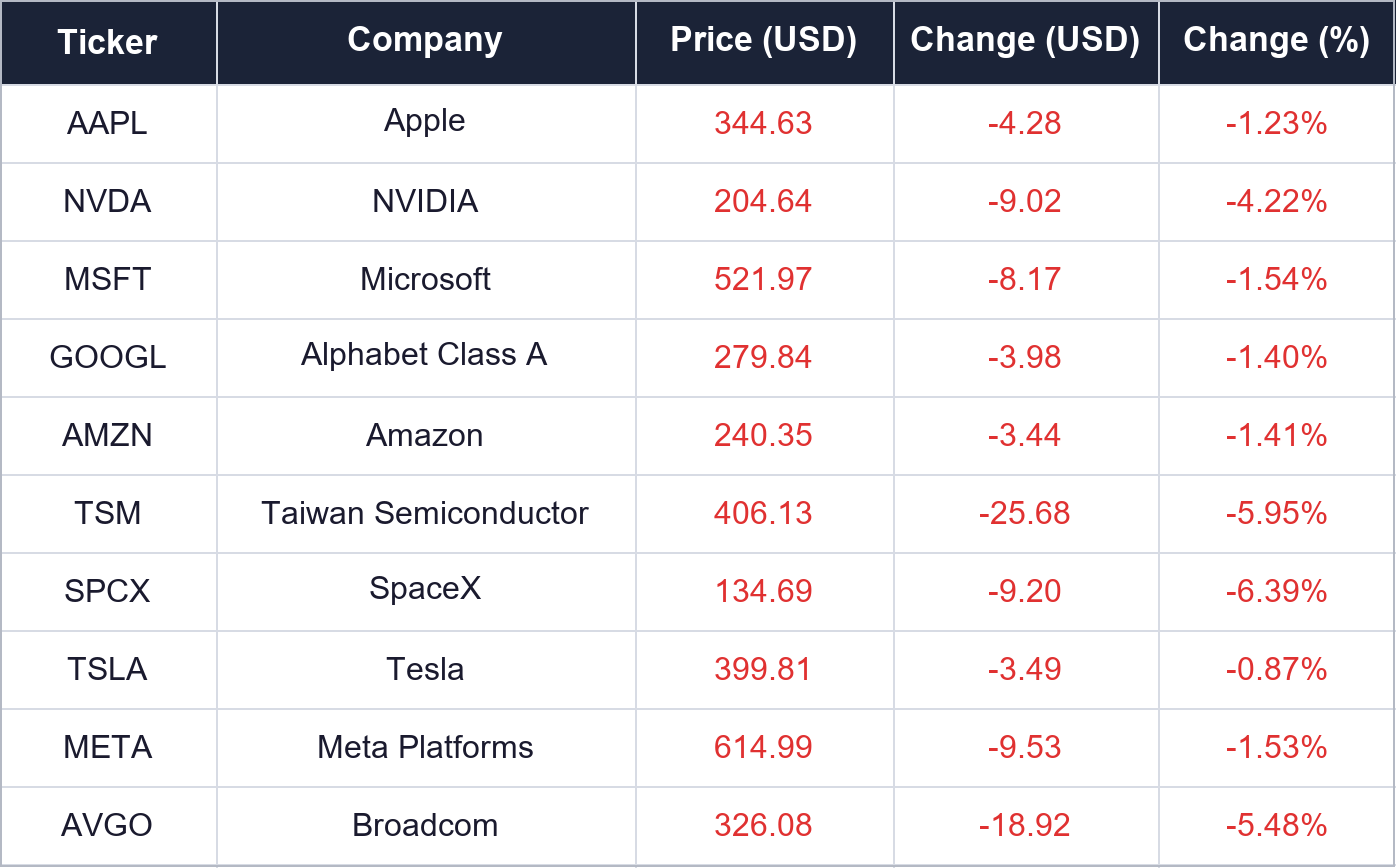
The performance of mega-cap tech stocks today is shown in the chart below:
The Philadelphia Semiconductor Index fell 7.2% to 10,688.8 points. Among its 30 constituents, 29 fell and 1 rose.
Chip stocks took a heavy hit, with Intel tumbling over 28%, SanDisk falling over 13%, Qualcomm dropping more than 11%, AMD declining over 10%, and TSMC and Broadcom down over 5%.
Company News
Blackstone Said to Believe Anthropic May Struggle to Secure Investment-Grade Rating Immediately Upon Listing
According to a Financial Times report citing people familiar with the matter, Blackstone told investors that Anthropic may not immediately obtain an investment-grade credit rating after going public, and is more likely to receive a rating of BB or higher. This assessment is more cautious than its previous expectation that the company would achieve an investment-grade rating before the end of the year. The report noted that restrictions on non-investment-grade debt investments faced by certain insurance companies and pension funds could constrain Anthropic's financing channels, leaving it to continue relying on suppliers with higher credit ratings for financing support.
UK CMA Investigates Meta Commercial Terms Over Publisher Content Usage
The UK Competition and Markets Authority (CMA) said Friday that it will investigate whether Meta (META) abused its market dominance through commercial terms to unfairly harm the interests of publishers and advertisers. The terms, which were originally scheduled to be revised starting November 20, could allow Meta to gather content from publisher websites without consent to develop products and services, including AI features. The proposed revisions have currently been paused. Meta responded that there is no justification for opening a competition investigation, stating it has committed not to modify the terms before consulting with publishers and other stakeholders.
Industry & Macro News
Fed's Logan: Fed Needs at Least 50 Basis Points More in Rate Hikes Before Pausing to Assess
Dallas Fed President Logan said Friday that the Fed still needs at least two 25-basis-point rate hikes, raising rates by a cumulative 50 basis points before pausing to assess economic and financial conditions. She supported maintaining the federal funds rate target range at 3.75% to 4% this week, but noted that skipping one rate hike would not change the ultimate policy goal.
Logan stated that financial conditions are currently still supporting economic growth and policy needs to tighten further to bring inflation back to 2%. Against the backdrop of market volatility heightened by tech investment prospects and geopolitical tensions, gradual rate hikes help reduce the risk of an unnecessarily sharp deterioration in economic activity. Regarding policy communication, Logan advocated clearly communicating policy goals, differing from Fed Chair Warsh's view of providing such guidance only during crisis periods. She believes that as long as the market understands the policy plan, the specific timing of rate hikes has a limited impact on long-term borrowing rates.
BofA: AI Debt Issuance Wave Weighs on Tech Bonds, Market Relief May Have to Wait Until First Half of 2027
Bank of America's Global Investment Strategy team noted in its weekly "Flow Show" report released on October 29 that debt issuance by AI hyperscalers has reached $182 billion this year, far higher than the $17 billion in 2024. New bond supply is weighing on tech bond performance, driving the total return of U.S. investment-grade tech bonds relative to the overall investment-grade bond index down to a 30-year low.
The report noted that global central banks have raised interest rates a cumulative 42 times over the past six months, with a stronger U.S. dollar and rising U.S. Treasury yields putting pressure on tech stocks. At the time of the report's release, the Philadelphia Semiconductor Index had fallen by about 20% from its peak.
Strategist Michael Hartnett believes that policymakers will not allow bond yields to rise in a disorderly fashion, and policy options such as Yield Curve Control (YCC) or Quantitative Easing (QE) could constrain yields. However, sustained relief from pressure on risk assets and AI stocks still relies on falling bond yields and easing financial conditions. He judges that this window is more likely to appear in the first half of 2027, with catalysts including progress toward geopolitical peace, a sharp fall in oil prices, and the end of the rate-hiking cycle.
Nothing in this material constitutes investment advice, personal recommendation, investment research, an offer, or a solicitation to buy or sell any financial instrument. The content has been prepared without consideration of your individual investment objectives, financial situation, or needs, and should not be treated as such.
Past performance is not a reliable indicator of future performance and/or results. Forward-looking scenarios or forecasts are not a guarantee of future performance. Actual results may differ materially from those anticipated.
Mitrade makes no representation or warranty as to the accuracy or completeness of the information provided and accepts no liability for any loss arising from reliance on such information.
Recommended Articles


