



CVS Stock Price Forecast: Shares Plunge 12% to Near Six-Month Low Despite Earnings Beat, Breakup Plan May Push Stock to $70
TradingKey - CVS Health (CVS) delivered an eighth consecutive quarter of results that topped market expectations, yet failed to win over investors. On November 4, the company announced plans to split its business into two independent publicly traded companies in the first half of 2028. Following the announcement, its shares plunged 12.5% to near six-month lows. Although both third-quarter revenue and adjusted earnings per share exceeded Wall Street estimates and the company raised its future earnings guidance, investors remain skeptical about the breakup plan's lack of concrete financial arrangements, the potential loss of synergies, and ongoing regulatory pressures.
Judging from its third-quarter earnings report, CVS's operational performance was actually quite solid. The company generated revenue of $108.4 billion, up about 5% year-over-year and above analyst expectations of $104.8 billion. Adjusted earnings per share reached $2.09, significantly topping market estimates of $1.65. Its medical benefit ratio (MLR), a measure of medical cost pressure in the insurance business, stood at 91.3%, below the market consensus of 92.3%. A lower ratio typically indicates that medical costs account for a smaller proportion of premium revenue, which is favorable for profitability. In addition, the company expects adjusted EPS to reach at least $8.65 in 2027, also exceeding Wall Street's average estimate of roughly $8.53.
However, the positive signals in the earnings report did not alleviate market concerns regarding the company's long-term business model. The restructuring plan announced by CVS aims to split its currently integrated healthcare operations into two independent publicly traded companies.
Going forward, CVS Health will continue to operate Aetna health insurance, Caremark pharmacy benefit management (PBM), specialty pharmacy, and healthcare services businesses such as Oak Street Health and Signify Health. The other company, CVS Pharmacy, will oversee retail pharmacies, MinuteClinic locations, mail-order pharmacies, and related consumer healthcare services. Under the current plan, the transaction is expected to close in the first half of 2028, at which point existing shareholders will hold shares in both companies.
This decision signals that CVS will gradually unwind the vertically integrated model it built through mergers and acquisitions over nearly two decades. The company announced its acquisition of Aetna for approximately $69 billion back in 2017, and subsequently continued to expand its pharmacy benefit management and healthcare services operations, aiming to enhance customer loyalty and scale through synergies among insurance, pharmacies, and care services.
However, as costs in the U.S. healthcare system have drawn growing scrutiny, issues such as drug pricing by PBMs, conflicts of interest between insurance and pharmacies, and healthcare service expenses have faced persistent regulatory examination. CVS's decision to split up is, to some extent, an effort to proactively realign its corporate structure and mitigate the regulatory and operational risks associated with vertical integration.
However, the core of market anxiety lies precisely in the plan's lack of sufficient quantitative backing. The company has yet to clarify how debt will be allocated, nor has it quantified separation costs, standalone operational expenses, or the loss of existing synergies. In the past, the retail pharmacy, insurance, and PBM units were able to share members, prescription volume, procurement channels, and back-office systems; following the split, these internal resources may turn into external transaction costs. Amid the absence of key data, investors find it difficult to assess whether the standalone valuations of the two companies will truly exceed the conglomerate's current valuation.
CVS must also confront operational headwinds that a breakup cannot resolve. Brick-and-mortar pharmacies face relentless pressure from prescription delivery, online pharmacies, and competitors like Amazon, while dwindling foot traffic also weighs on front-store general merchandise sales. Meanwhile, the insurance business continues to shoulder cost pressures from elevated healthcare utilization. Although the medical benefit ratio improved during the quarter, medical cost trends across Medicare Advantage, Medicaid, and commercial insurance could still squeeze future profits. Furthermore, a 0.6% decline in third-quarter same-store sales indicates that the retail segment has yet to regain stable growth.
Source: TradingView
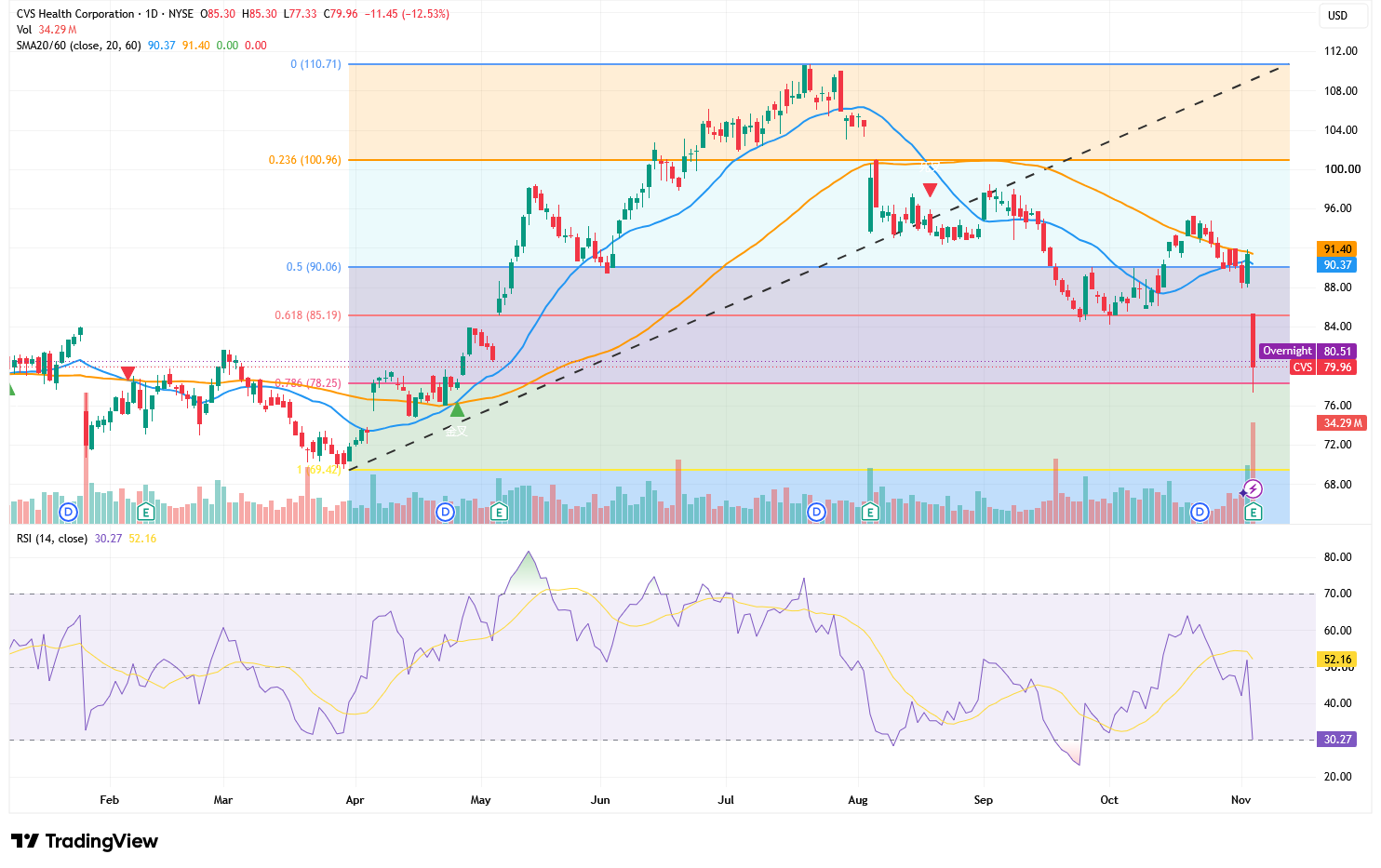
From a technical perspective, CVS has fallen below its 20-day moving average of $90.37 and 60-day moving average of $91.40, with the two lines forming a strong resistance zone at $90–$91. Meanwhile, the stock broke below its ascending trendline in place since April, signaling that the prior rebound structure has been compromised.
Fibonacci retracement levels show that $78.25 represents the 0.786 retracement level and serves as the most critical near-term support. Intraday, the stock plunged to as low as $77.33; although it closed back above this level, the long bearish candlestick on heavy volume indicates that bears remain in firm control. If subsequent closes confirm a break below $78.25, the stock could slide further toward $76 and subsequently test its prior lows of $69.42–$70, representing about 13% downside from current levels.
The RSI has dropped rapidly from above 50 to 30.27, nearing oversold territory and opening the door for a potential near-term technical rebound. However, an oversold condition does not equate to a trend reversal. On the upside, the stock first needs to reclaim $85.19 and then break through the dual moving-average resistance zone at $90–$91 to mitigate current downside risks; otherwise, any bounce could still be viewed merely as a corrective consolidation within a broader downtrend.
Nothing in this material constitutes investment advice, personal recommendation, investment research, an offer, or a solicitation to buy or sell any financial instrument. The content has been prepared without consideration of your individual investment objectives, financial situation, or needs, and should not be treated as such.
Past performance is not a reliable indicator of future performance and/or results. Forward-looking scenarios or forecasts are not a guarantee of future performance. Actual results may differ materially from those anticipated.
Mitrade makes no representation or warranty as to the accuracy or completeness of the information provided and accepts no liability for any loss arising from reliance on such information.
Recommended Articles


