



TradingKey Wall Street Weekly: Nvidia and Anthropic Deepen AI Selloff; Nasdaq Plunges 10.02% and Erases 2026 Gains
Market Review and Analysis
TradingKey - The macroeconomic backdrop throughout the week was dominated by persistent inflation concerns and a hawkish recalibration of Federal Reserve policy expectations. Following October inflation readings that showed consumer prices expanding 0.4% month-over-month and producer prices rising 6.5% year-over-year, market participants aggressively priced in continued monetary tightening, with interest rate futures indicating approximately an 82% to 90% probability of an additional 25-basis-point rate hike at the December Federal Open Market Committee meeting. Benchmark Treasury yields remained under upward pressure, with the 10-year Treasury yield fluctuating between 4.91% and 5.15% after surging in prior sessions, while the average 30-year fixed mortgage rate climbed to 7.28%. Compounding the macro headwinds, geopolitical friction intensified in the Middle East following maritime incidents and drone interceptions near the Strait of Hormuz, while domestic policy discourse introduced fresh uncertainty regarding potential tax liabilities and restrictions on international artificial intelligence data center construction.
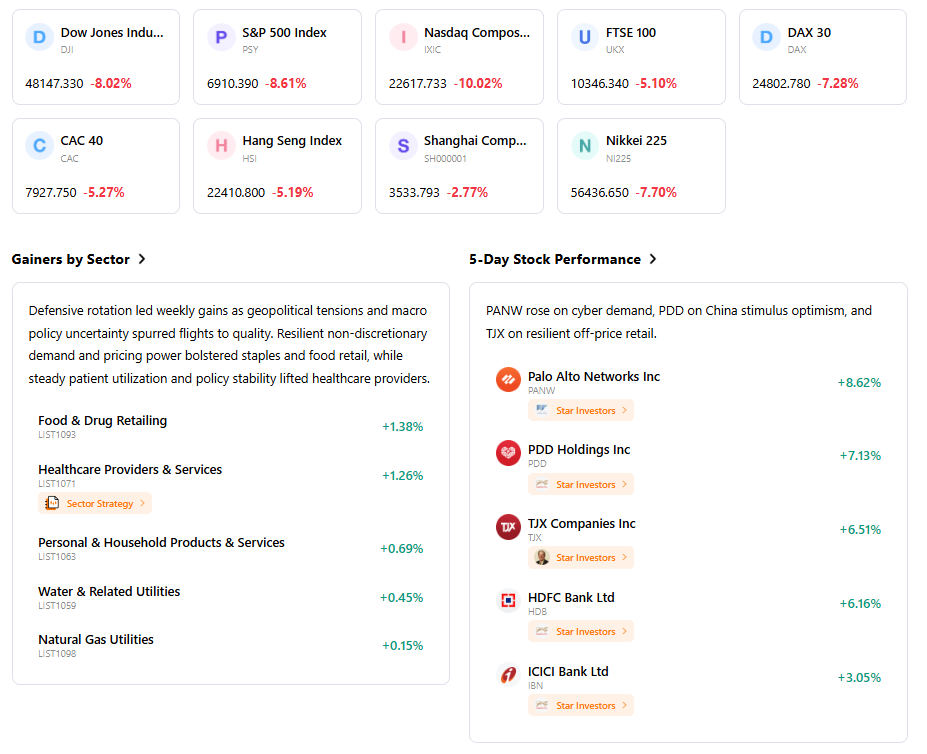
U.S. equities suffered severe, broad-based liquidation during the week of November 16 to November 20, 2026, culminating in the steepest weekly declines for major benchmarks in over eighteen months. The S&P 500 dropped from a weekly open of 7,561.67 to close at 6,910.39, declining 651.28 points or 8.61% for the week and officially entering technical correction territory, down 11.62% from its October 6 peak. The tech-heavy Nasdaq Composite sank 2,518.54 points or 10.02% to settle at 22,617.73, fully wiping out its year-to-date gains to stand down 2.7% for 2026. The Dow Jones Industrial Average dropped 4,200.22 points or 8.02% to finish at 48,147.33, also entering correction territory, while the small-cap Russell 2000 surrendered 208.70 points or 7.48% to end at 2,581.79. Sector breadth deteriorated sharply, with Information Technology plummeting 9.62% on the week to lead all sectors lower, accompanied by heavy selling across communication services and industrials. Style rotation favored defensive value over growth, as consumer staples stood as the sole pocket of relative resilience while momentum and high-multiple growth equities experienced widespread capitulation.
Key events during the week centered on pivotal central bank communication, regulatory developments, and critical corporate earnings. On November 16, Eastern Time, Federal Reserve Chair Kevin Warsh addressed the Productivity and Jobs Task Force Conference in San Francisco, presenting illustrative scenarios on superintelligence and cautioning that unrealized technological returns could trigger sharp valuation compression and economic drag. Simultaneously, newly released Federal Reserve meeting minutes revealed that central bank staff flagged off-balance-sheet leasing commitments and circular financing structures among technology firms as potential systemic amplifiers. Corporate earnings added further strain; Nvidia's quarterly report, its first following the departure of former chief executive Jensen Huang, disclosed 102 billion dollars in data-center lease and cloud commitments, which was subsequently compounded by reports of regulatory accounting scrutiny that drove double-digit losses across semiconductor leaders. In primary markets, the public market debut of Anthropic priced at 83 dollars per share and initially traded above 115 dollars, but fizzled into Friday with a steep drop to 88.30 dollars, failing to stem the wider tech de-risking despite solid earnings from retail anchors Walmart and Target.
Capital flows and investor sentiment reflected an acute shift toward liquidity preservation and cross-asset de-leveraging. The Cboe Volatility Index spiked dramatically over the five-day period, advancing from sub-20 levels to close at 35.89, reaching as high as 37.67, its highest reading since March and signaling elevated institutional demand for downside portfolio protection. Digital assets endured forced liquidations exceeding 600 million dollars in crypto futures, with Bitcoin sliding below 60,000 dollars and U.S. spot Bitcoin exchange-traded funds posting record single-day net outflows. Commodity markets also exhibited signs of cash-raising behavior, as gold fell nearly 4% on Friday to 3,539.00 dollars per ounce, extending to fresh multi-month lows alongside softening crude prices, while the U.S. dollar index strengthened as the global reserve currency absorbed defensive flows.
In terms of overall market assessment, the equity complex has transitioned from an extended momentum expansion into an aggressive valuation repricing and liquidity correction phase. The core market logic has shifted from speculative multiple expansion toward an intense scrutiny of capital return timelines, exacerbated by the prospect of a more restrictive Federal Reserve interest rate trajectory. Cyclically, this phase exhibits hallmark features of mid-to-late cycle volatility, where deteriorating market breadth, regulatory scrutiny, and tightening financial conditions force a painful compression of excessive market concentration.
Next Week’s key market drivers and Investment Outlook
Upcoming events will be framed by a holiday-shortened trading schedule alongside key macroeconomic releases and corporate updates. Market participants will focus on revised third-quarter Gross Domestic Product data, October Personal Consumption Expenditures inflation figures, durable goods orders, and initial jobless claims. Investors will also parse speeches from multiple Federal Reserve officials ahead of the pre-December meeting blackout window, seeking confirmation regarding whether the central bank intends to enact a 25-basis-point or larger rate hike at the upcoming FOMC gathering. On the micro front, late-reporting retail and enterprise software earnings will provide a health check on consumer resilience and corporate software budgets heading into the year-end shopping season.
Market logic projection points toward a fragile equilibrium as asset prices digest the recent breakdown in market structure. Macro conditions are likely to remain constrained by sticky wage and services inflation, keeping short-term interest rates elevated and limiting the scope for any near-term central bank accommodation. From a micro-fundamental perspective, the initial shock of technology leadership turnover and capital expenditure financing questions has driven index-level technical indicators into deeply oversold territory, which could pave the way for tactical, short-covering bounces. However, any sustainable floor in equities will require evidence of credit spread stability and clarity regarding capital-spending durability outside of circular financing channels.
Strategy and allocation recommendations dictate maintaining a cautious, capital-preservation-oriented posture with disciplined risk-budgeting. Institutional investors should continue rotating out of capital-intensive, high-valuation technology hardware and speculative artificial intelligence infrastructure, redirecting capital into high-quality defensive sectors with robust balance sheets, strong pricing power, and resilient free cash flow yields, such as consumer staples, healthcare, and regulated utilities. Representative equity allocations include defensive cash-flow compounders such as Walmart, UnitedHealth Group, and Johnson & Johnson, alongside allocations to short-duration Treasury bills and cash equivalents to capture attractive risk-free yields while market volatility subsides.
Risk alerts warrant close monitoring across several transmission channels. The primary risk remains an aggressive hawkish surprise, where incoming inflation readings or central bank rhetoric push December rate hike expectations toward a 50-basis-point increase. A secondary risk involves regulatory contagion, specifically if formal accounting investigations into tech supply-chain financing trigger broader credit downgrades or restricted access to capital markets. Finally, persistent geopolitical instability in critical energy shipping corridors could provoke an unexpected spike in crude oil prices, generating stagflationary headwinds that would further compress corporate margins and challenge multi-asset portfolio performance.
Markets Weekly
5-Day Index Performance
Nothing in this material constitutes investment advice, personal recommendation, investment research, an offer, or a solicitation to buy or sell any financial instrument. The content has been prepared without consideration of your individual investment objectives, financial situation, or needs, and should not be treated as such.
Past performance is not a reliable indicator of future performance and/or results. Forward-looking scenarios or forecasts are not a guarantee of future performance. Actual results may differ materially from those anticipated.
Mitrade makes no representation or warranty as to the accuracy or completeness of the information provided and accepts no liability for any loss arising from reliance on such information.
Recommended Articles


