



Musk Says Renting Computing Power More Profitable Than In-House Grok; Anthropic Early Termination May Pressure SpaceX Stock
TradingKey - Speculation that Anthropic (ANT) may stop leasing SpaceX (SPCX) computing power after mid-2027 is mounting. For SpaceX shareholders, the risk is that once all computing power is delivered, the contract corresponds to roughly $3.1 billion in monthly rental revenue, but the client can issue a termination notice as early as early 2027. Once Anthropic decides to scale back the partnership, the market may lower earnings expectations for SpaceX before rental revenue actually declines.
The New York Times reported, citing people familiar with the matter, that Elon Musk previously admitted to employees that Grok lags behind rivals in AI model development, and that at this stage, it is more profitable for SpaceX to lease computing power to companies such as Anthropic and Google than to reserve it for Grok.
When Can Anthropic's Compute Contract Be Terminated?
Anthropic's prospectus shows that the company expects SpaceX to deliver all agreed-upon computing power by December 2026, at which point the combined monthly fees for the two agreements will be approximately $3.1 billion. Although the contract term extends through 2029 with a cumulative spending cap of approximately $120.5 billion, the initial non-cancellable terms of the two agreements end in January and March 2027, respectively. Thereafter, either party may terminate the respective agreement with 90 days' prior written notice. As the two dates correspond to different agreements, the $3.1 billion monthly fee will not expire simultaneously when the first window opens.
Currently, claims of 'stopping leases after mid-2027' stem from second-hand meeting minutes circulating on X. Elon Musk responded that SpaceX would be happy to take back the computing power, but he judged that the reality may be the opposite. He subsequently stated at the DealBook event that, based on his communications with Anthropic, the company is very likely to continue leasing and hopes to obtain more computing power. Neither party has yet announced orders regarding this additional demand.
How Will Early Termination Affect SpaceX Stock Price?
SpaceX has announced plans to invest $74 billion to expand data centers. If Anthropic issues a termination notice and other customers cannot step in promptly at comparable prices, SpaceX will face shrinking rental income while equipment depreciation continues. At that point, investors would have to both lower near-term profit expectations and recalculate how many years it will take for the new data centers to recoup their investment, both of which could weigh on the stock price.
SpaceX could re-lease the reclaimed GPUs or redeploy them to support Grok. Musk previously told employees that leasing compute power is currently more profitable than reserving it for Grok. Therefore, even if these GPUs are quickly put back into service, whether they can make up for the original rental revenue will still depend on the prices new customers are willing to pay or how much incremental revenue Grok can generate.
A more consequential signal for the stock price is whether Anthropic officially issues a termination notice or, conversely, places additional orders and extends the non-cancellable period. The former would establish a clear timeline for the revenue risk, while the latter would give investors greater confidence in factoring future rental income into SpaceX's valuation.
SpaceX Technical Analysis
From a technical standpoint, SpaceX gapped higher at the open before pulling back noticeably. Although it was still up 5.62% intraday from the previous close, the current price has dropped below the open, temporarily forming a bearish candle on the daily chart. Intraday, the stock briefly broke above the 0.382 Fibonacci retracement level ($141.79) before retreating below all five exponential moving averages (EMAs), remaining in a weak rebound phase in the short term following its decline.
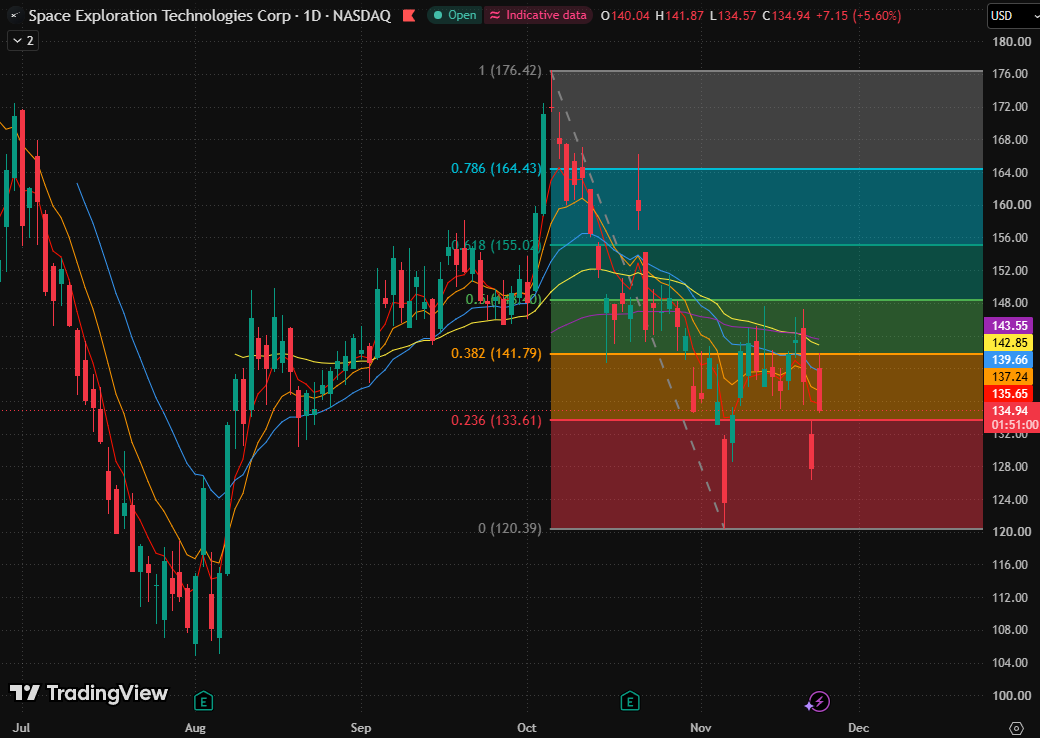
SpaceX daily stock chart, Source: TradingView
In terms of moving averages, the 5-day exponential moving average ($135.66) has become the nearest dynamic resistance, followed above by the 10-day exponential moving average ($137.25) and the 20-day exponential moving average ($139.66). Meanwhile, the 80-day exponential moving average ($142.86) and the 160-day exponential moving average ($143.56) continue to decline. With all five moving averages maintaining a fully bearish alignment, any rebound continues to face resistance at every level.
In terms of rebound potential, the stock still needs to reclaim the 0.382 Fibonacci retracement level ($141.79) and hold above it on a subsequent pullback for the short-term recovery to extend. This price zone also faces multiple layers of overhead resistance from both the 80-day and 160-day exponential moving averages.
On the downside, if the stock breaks below $133.61 and fails to reclaim it on a bounce, this gap-up recovery will weaken. Primary support below lies in the previous session's low zone of approximately $126–$128, as well as the early-November low ($120.39).
Nothing in this material constitutes investment advice, personal recommendation, investment research, an offer, or a solicitation to buy or sell any financial instrument. The content has been prepared without consideration of your individual investment objectives, financial situation, or needs, and should not be treated as such.
Past performance is not a reliable indicator of future performance and/or results. Forward-looking scenarios or forecasts are not a guarantee of future performance. Actual results may differ materially from those anticipated.
Mitrade makes no representation or warranty as to the accuracy or completeness of the information provided and accepts no liability for any loss arising from reliance on such information.
Recommended Articles


