


NVDA Jumps 31% on Jensen Huang's Return, With $164.60 Now the Line to Hold
TradingKey - Nvidia (NASDAQ: NVDA) rose $39.52, or 31.48%, to $165.05 on Monday, November 23, according to Nvidia's investor relations site, after its board reinstated Jensen Huang as president and CEO, effective immediately. It was the stock's biggest one-day percentage gain in more than two decades, according to the Motley Fool, and added nearly $1 trillion in market value.
The jump came one session after Nvidia fell 14.0% to $125.53, near its 52-week low of $124.50, on a report that securities regulators are examining its accounting. Volume reached about 783 million shares, and the stock traded between $156.93 and $171.50. The question for Tuesday is whether buyers can hold the gain while the regulatory questions stay open.
What the Board Said
In its November 23 release, Nvidia said the board voted unanimously to reinstate Huang after a series of discussions and meetings, after which it was "satisfied with respect to Mr. Huang's candor and ability to lead." It added that it received input from senior levels of the US government and is confident his return "poses no national security risk."
Board chair Harvey Jones, who stays in his role, said, "The Board believes Jensen is the right person to lead NVIDIA." Colette Kress, who served as interim CEO, continues as chief financial officer. The decision reverses the board's stance from the third-quarter call a week earlier, when Jones said it would not bring Huang back.
The release also said a committee of independent directors will finish its investigation into recent reporting that Huang was the target of a foreign intelligence effort, and that Huang supports it. Nvidia is creating a new Chief Compliance Officer role and said it "will continue to cooperate with ongoing government investigations and inquiries."
The SEC Questions Are Still There
Notice what did not happen, though. Nvidia's release did not address the reports that drove Friday's drop. Reuters, citing two people briefed on the matter, reported that SEC enforcement staff are examining potential accounting issues at Nvidia. Separately, the Wall Street Journal reported last week that the SEC has opened a civil probe into whether Nvidia's disclosures misled investors. Neither is a charge, and the company has not confirmed either review.
So the leadership discount came off the stock, but the regulatory risk did not. Even after Monday's rally, Nvidia remains about 32% below its 52-week high of $243.37.
The Rally Lifted the Whole Market
Nvidia's gain pulled the broader market higher. The Nasdaq Composite jumped 6.51% and the S&P 500 rose 4.73%, according to CNBC. AI names followed: AMD gained 6.85% to $453.46, Broadcom rose 3.00% to $313.55, CoreWeave rose 22.32% and Nebius gained 20.28%, according to Yahoo Finance and CNBC.
The business numbers behind the stock have not changed. Third-quarter revenue rose 103% to a record $115.8 billion, data center revenue reached $107.6 billion, and Nvidia guided fourth-quarter revenue to $130 billion, plus or minus 3%, an outlook that already assumes no data center compute revenue from China.
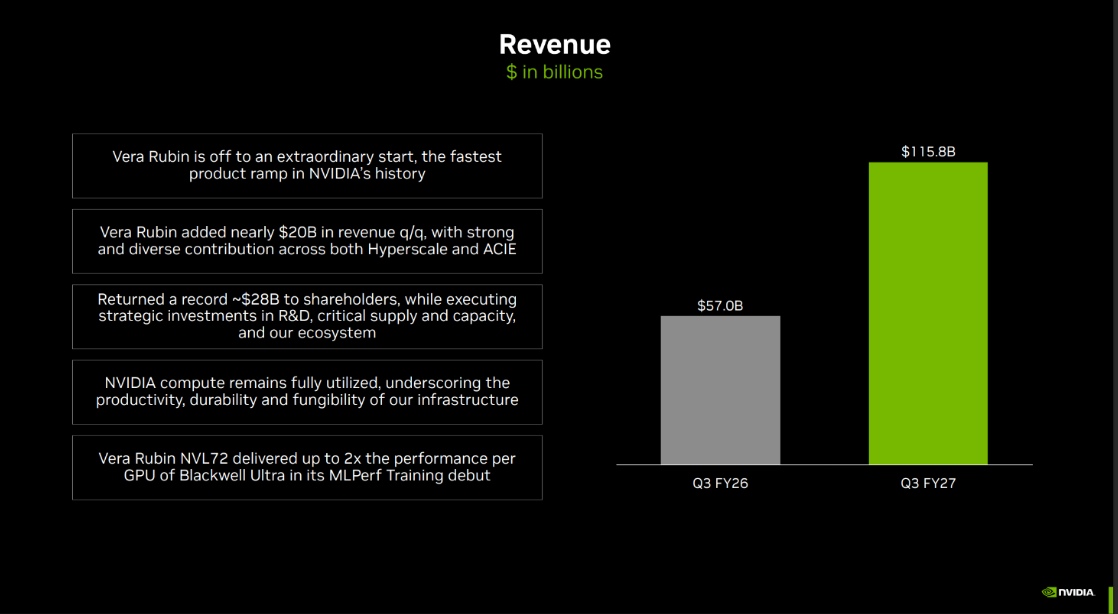
Source: Nvidia Q3 FY27 investor presentation, November 2026
Trefis puts next year's base-case EPS at $12.50, which values the stock at about 13 times at $165.05, by my calculation, a low multiple for that kind of growth. Morgan Stanley's $260 target, set last week with an Overweight rating, sits about 58% above Monday's close.
A Short Week With Busy Catalysts
Dell reports after the close on Tuesday, which should give a fresh read on AI server demand. US markets are closed on Thursday, November 26, for Thanksgiving and close early on Friday, so thin trading could make moves larger than usual. Nvidia will also present at the UBS Global Technology and AI Conference on Tuesday, December 1, its first scheduled investor appearance since Huang's return.
Nvidia Technical Analysis: Daily Close Below $146.31 Could Reopen $124.01
That swing shows up clearly on the daily chart. Sellers dragged the stock down to the $124.01 support zone, then buyers drove it back above $146.31 and the $164.60 pivot, leaving a long lower wick, a sign of aggressive dip-buying. The bigger trend is still damaged, though, with price well below the red moving average, which tracks the average price over recent sessions, at $194.63.
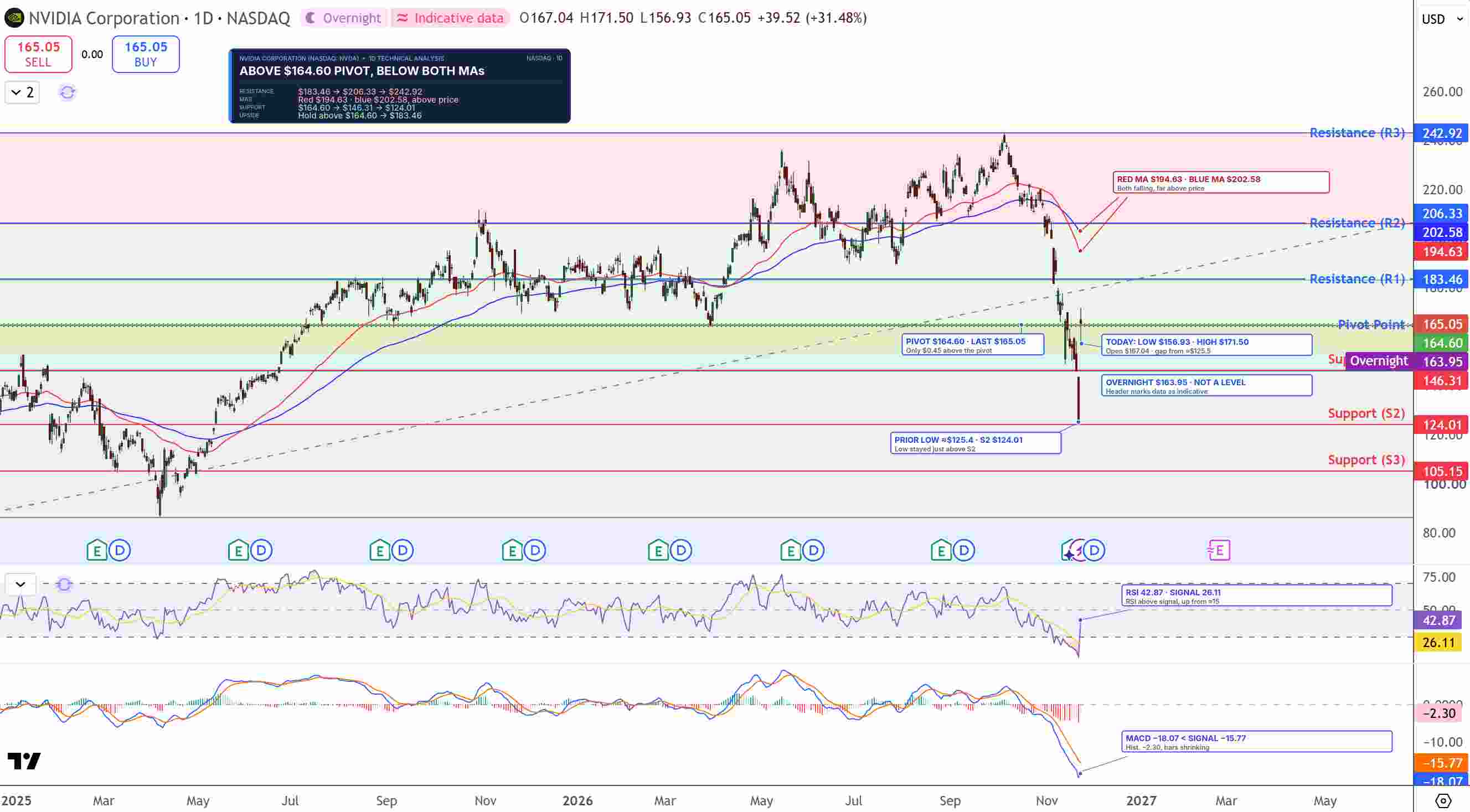
NVDA Price Chart - Source: Tradingview
RSI, a gauge of buying and selling strength that runs from 0 to 100, has jumped to about 43 from deep oversold levels and crossed above its signal line. The MACD, another momentum indicator, is still deeply negative, but its bars are shrinking, so selling pressure is fading.
Monday closed just above the $164.60 pivot. Daily closes that hold above it could open $183.46, followed by $194.63. On the downside, a daily close below $146.31 would put $124.01 back in play.
I'm cautiously bullish in the short term while NVDA holds above $146.31, and $183.46 is the next target.
Key Levels
- Last close: $165.05, up 31.48% on Monday, November 23 (overnight: $163.95)
- Support: $164.60, $146.31, $124.01
- Resistance: $183.46, $194.63
- RSI: 42.87
- Bullish trigger: Daily closes holding above $164.60
- Bearish trigger: Daily close below $146.31
FAQs
Why did Nvidia stock jump 31% on Monday?
Nvidia rose 31.48% to $165.05 on Monday, November 23, after its board unanimously reinstated Jensen Huang as president and CEO. The board said it received input from senior levels of the US government and is confident his return poses no national security risk.
What is the Nvidia stock forecast now?
The bias is cautiously bullish in the short term while NVDA holds above $146.31. Daily closes above the $164.60 pivot could open $183.46 and $194.63, while a daily close below $146.31 could send the stock back toward $124.01.
Bottom Line
Nvidia's board removed the leadership question, and the market repriced the stock almost overnight. The level that matters now is $164.60. In my view, holding above it through this short week would support a move toward $183.46, while any confirmed SEC action could quickly push the stock back toward $146.31.
Nothing in this material constitutes investment advice, personal recommendation, investment research, an offer, or a solicitation to buy or sell any financial instrument. The content has been prepared without consideration of your individual investment objectives, financial situation, or needs, and should not be treated as such.
Past performance is not a reliable indicator of future performance and/or results. Forward-looking scenarios or forecasts are not a guarantee of future performance. Actual results may differ materially from those anticipated.
Mitrade makes no representation or warranty as to the accuracy or completeness of the information provided and accepts no liability for any loss arising from reliance on such information.
Recommended Articles


