



Amazon Plans to Acquire Decart for About $7.5 Billion, Threatening Nvidia Data Center AI Chips
TradingKey - Amazon spends approximately $7.5 billion to acquire Decart to bolster Trainium compute power, potentially threatening Nvidia's data center dominance over the medium to long term.
On November 23, Eastern Time, Amazon (AMZN) officially announced plans to spend approximately $7.5 billion to acquire the Decart Optimization Stack (DOS), the core proprietary software technology of Israeli AI startup Decart, while bringing its three co-founders and top R&D team of about 100 to 120 people on board. Following the announcement, Amazon's stock gained over 4% in aggregate across regular and after-hours trading sessions.
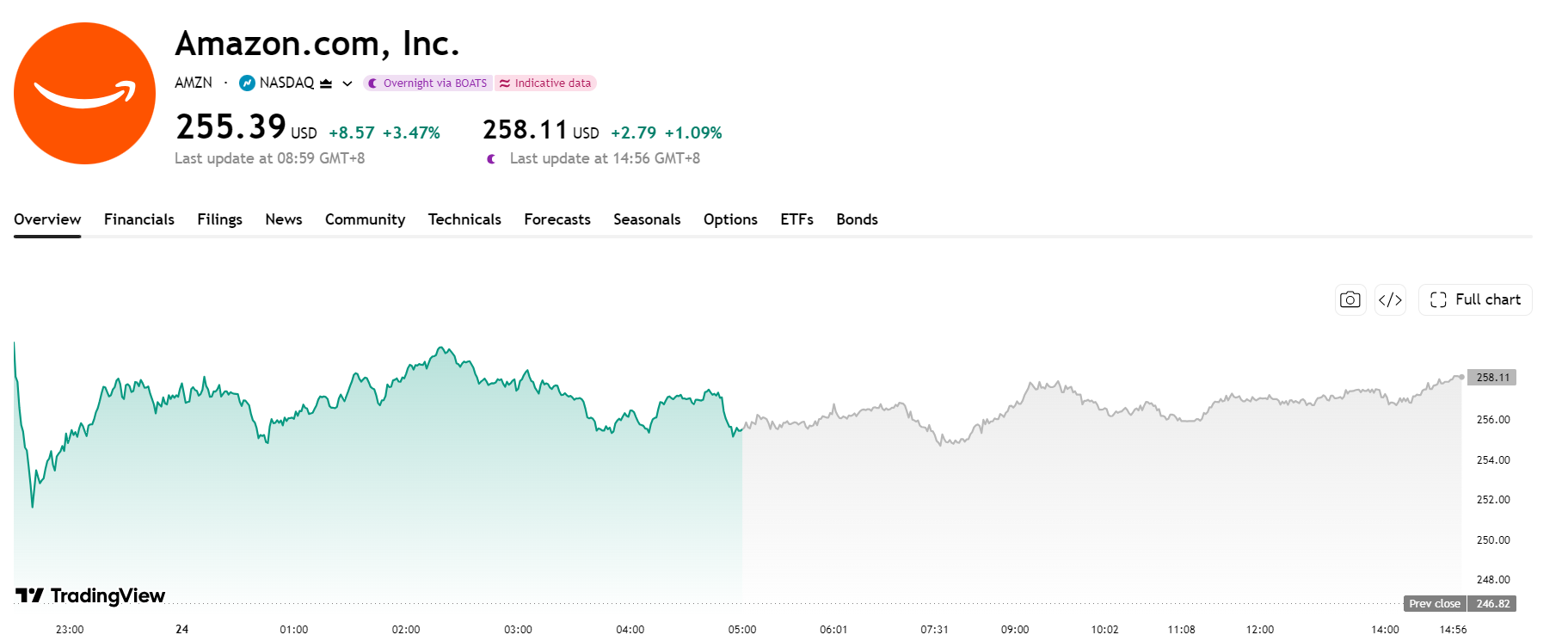 Amazon stock price chart, Source: TradingView
Amazon's transaction not only sets a significant record for Israel's AI sector and Amazon's recent infrastructure acquisitions, but is also widely interpreted by Wall Street and the semiconductor industry as a key strategic puzzle piece in its preparations to officially sell its in-house Trainium chips externally in 2027 and mount a direct challenge to Nvidia (NVDA)'s dominance in data center AI chips.
Founded in 2023, Decart boasts an exceptionally star-studded shareholder roster, including Sequoia Capital, Benchmark, Radical Ventures, Nvidia, and others. Reportedly, both Nvidia and Anthropic had engaged in acquisition talks with Decart, but Anthropic withdrew after due diligence. Ultimately, it was Amazon, which had been deeply collaborating with Decart since 2025 to test Trainium3, that laid the groundwork to emerge as a rival to Nvidia.
Over the past several years, the reason Nvidia has been able to capture more than 80% market share and staggering gross margins in the data center AI accelerator market lies not only in the compute leadership of hardware architectures like Hopper, Blackwell, or Rubin, but even more so in the CUDA software ecosystem moat it spent over a decade building. Amazon's acquisition of Decart is precisely a hardware-software integration breakthrough targeting Nvidia's ecosystem defenses.
First, the core value of DOS lies in its deep low-level software optimization and cross-hardware compilation and scheduling capabilities. Without sacrificing model precision, it can significantly alleviate memory bandwidth bottlenecks and compute latency during training and inference, enabling enterprise AI workloads to migrate more seamlessly from Nvidia GPU platforms to run on Amazon Trainium chips, thereby fundamentally eroding CUDA's user stickiness.
Second, Amazon CEO Andy Jassy plans to sell Trainium chips directly to third-party data center builders and large enterprise customers starting in 2027. This means Amazon will officially evolve from a major customer and cloud rental alternative of Nvidia into a direct competitor in chip hardware and system solutions.
In the short term, Nvidia's leading position will not be shaken overnight—after all, Nvidia has just seen market confidence restored by Jensen Huang's reinstatement, and its full-stack systems and customer lock-in effects remain profound. Over the medium to long term, however, Amazon's strategic moves pose a potentially major threat to Nvidia. The concrete impact can be evaluated by whether Amazon can successfully secure large-scale procurement orders from independent AI labs beyond Anthropic, sovereign AI initiatives, or second-tier cloud service providers after officially launching external sales of Trainium chips next year.
Nothing in this material constitutes investment advice, personal recommendation, investment research, an offer, or a solicitation to buy or sell any financial instrument. The content has been prepared without consideration of your individual investment objectives, financial situation, or needs, and should not be treated as such.
Past performance is not a reliable indicator of future performance and/or results. Forward-looking scenarios or forecasts are not a guarantee of future performance. Actual results may differ materially from those anticipated.
Mitrade makes no representation or warranty as to the accuracy or completeness of the information provided and accepts no liability for any loss arising from reliance on such information.
Recommended Articles


