



SK Hynix Highs Continue to Decline Toward Recent Lows as Key $100 Support Faces Test
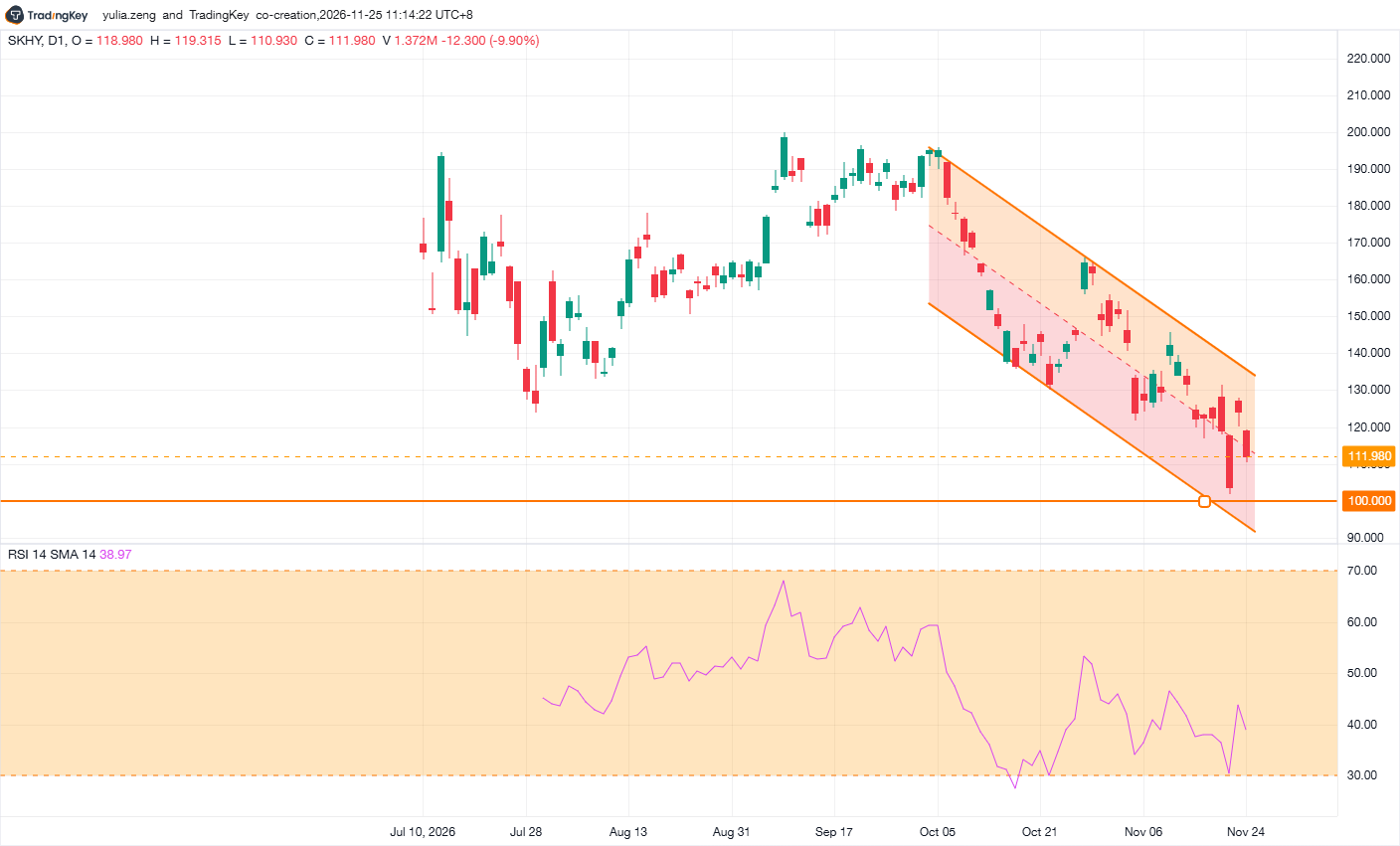
TradingKey - Shares of SK Hynix (SKHY) continued their downward trend, plunging 9.9% in the latest trading session to close at $111.98 after touching an intraday low of $110.93. Since peaking near $195 in late September, the stock has posted successively lower rebound highs and pullback lows, trading within a downward channel.
Goldman Sachs (GS) recently reassessed the outlook for the global memory chip industry, maintaining "Buy" ratings on Samsung Electronics and SK Hynix while sharply cutting target prices for both companies. Specifically, SK Hynix's target price was lowered from 3.5 million won to 2.0 million won, a 43% reduction.
Goldman Sachs expects artificial intelligence infrastructure investment to continue driving server memory demand. In 2027, the global DRAM market could face its most severe supply shortage in 15 years, with the DRAM supply deficit widening to 5.1%. The tight supply-demand dynamic is expected to continue supporting memory chip prices and the earnings performance of major manufacturers.
What Goldman Sachs is truly concerned about is the industry outlook for 2028. As new capacity is gradually brought online, particularly as Chinese memory chipmakers accelerate expansion, DRAM supply growth could catch up with demand again. Meanwhile, memory demand in the smartphone and PC markets is expected to slow, and the global DRAM supply deficit could narrow rapidly from 5.1% in 2027 to 1.2% in 2028, gradually returning the industry to balanced supply and demand.
Under this assumption, Goldman Sachs projects that SK Hynix's conventional DRAM prices could drop by about 19% year-over-year in 2028, while NAND prices could also fall by nearly 20%. Weighed down by falling product prices, the bank lowered its 2028 operating profit forecast for SK Hynix by roughly 23%, which is also the primary reason for the sharp cut in the company's target price.
However, SK Hynix's order visibility remains high. The company stated that, based on signed long-term supply agreements and procurement demand currently being negotiated with customers, its DRAM and HBM capacity is essentially locked in through 2029. Among these, long-term agreements cover more than 50% of capacity for 2027 and 2028, with HBM procurement demand from some customers even exceeding twice the company's available supply scale.
While expanding its HBM business, SK Hynix is also strengthening its strategic footprint in the NAND sector. On November 20, the company announced that it would convert approximately 129 billion yen (equivalent to roughly $810 million) of convertible bonds into shares and acquire an additional stake from Bain Capital. Following the transaction, SK Hynix will indirectly hold approximately 14.1% of Kioxia's shares through a special purpose company, becoming its largest indirect shareholder.
Source: TradingKey
From a daily chart perspective, SK Hynix has fallen into the lower half of its downward channel and is currently only about 10% away from horizontal support near $100. If the stock can halt its decline near $100 to $102 alongside contracting volume, a short-term technical rebound could emerge, with an initial rebound target at $120 to $125, followed by the channel resistance zone near $130 to $135.
However, before the stock breaks back above the upper boundary of the downward channel, any recovery is closer to an oversold rebound rather than a trend reversal. If the daily chart decisively breaks below $100, prior support could turn into resistance, and bears may push prices further toward the $90 to $95 zone, implying roughly 10% to 15% of potential downside remaining for the stock.
Nothing in this material constitutes investment advice, personal recommendation, investment research, an offer, or a solicitation to buy or sell any financial instrument. The content has been prepared without consideration of your individual investment objectives, financial situation, or needs, and should not be treated as such.
Past performance is not a reliable indicator of future performance and/or results. Forward-looking scenarios or forecasts are not a guarantee of future performance. Actual results may differ materially from those anticipated.
Mitrade makes no representation or warranty as to the accuracy or completeness of the information provided and accepts no liability for any loss arising from reliance on such information.
Recommended Articles


