



Indian Rupee starts the week negatively amid higher oil prices
- The Indian Rupee declines at open against the US Dollar due to a rise in oil prices over the weekend.
- US President Trump pushes back hopes of near-term diplomacy with Iran.
- Analysts at MUFG expect the RBI to deliver 50bps interest rate hike in the remaining year.
The Indian Rupee (INR) starts the week on a negative note against the US Dollar (USD) due to significant gains in oil prices over the weekend. As of writing, the USD/INR pair is up 0.15% to near 95.95.
In the opening session, the MCX Crude Oil contract expiring on October 19 is up 2.22% to near Rs. 9,045.
Currencies from economies, such as India, which rely heavily on oil imports to meet their energy needs, tend to underperform in a high-oil-price environment.
Meanwhile, the Reserve Bank of India (RBI) continues to provide support to the Indian currency through intervention in both spot and Non-Deliverable Forwards (NDFs) markets. "Nearly every day we have seen some amount of interventions, which signals that the RBI wants to keep a firm floor under the rupee for now, traders say, Reuters reported.
What caused a significant increase in oil prices over the weekend?
Oil prices attracted significant bids as United States (US) President Donald Trump pushed back hopes of diplomacy with Iran, adding that additional military strikes before the midterm elections are possible, Fox News reported. Trump expressed confidence that Washington is going to win this war very soon, and as soon as we win it, the oil will go down, way down to what it was before the war.
Meanwhile, Iran’s Foreign Minister, Abbas Araghchi, says his country is open to “real diplomacy” but ready for an “apocalyptic war” if the US attacks again, Al Jazeera reported.
US Yields remain key concern
Elevated US bond yields due to firm expectations that the Federal Reserve (Fed) will hike interest rates again this year continue to remain a key concern for riskier assets. 10-year US Treasury Yields remain firm near its 19-year high of 5.23% posted on Friday.
Strategists at OCBC note that the recent run of resilient US data and sticky inflation has translated into firmer expectations for further Fed action, with “market pricing currently implies around a 70% probability of another 25bp rate hike in October, highlighting the market's growing conviction that the Fed's inflation fight is not yet over.”
RBI caution persists as inflation risks linger despite subdued headline prints
Analysts at Commerzbank highlight that, although "year-to-date CPI inflation has averaged 3.8%, below the Reserve Bank of India's (RBI) FY2026-2027 forecast of 5.0%", the underlying price backdrop remains concerning. They argue that "the persistence of cost pressures suggests policymakers will likely maintain a cautious stance," reinforcing their view that the RBI will stay in "wait-and-see mode." In Commerzbank’s assessment, "higher global crude oil prices and evidence of second-round effects continue to pose upside risks to the inflation outlook," keeping the central bank wary even as headline inflation runs below target projections.
Contrary to the view from Commerzbank, strategists at MUFG view firm domestic growth and signs of broadening in core pressures are strengthening the case for a shallow 50bp hike in second half of FY27, making October’s meeting a live one.
USD/INR Technical Analysis
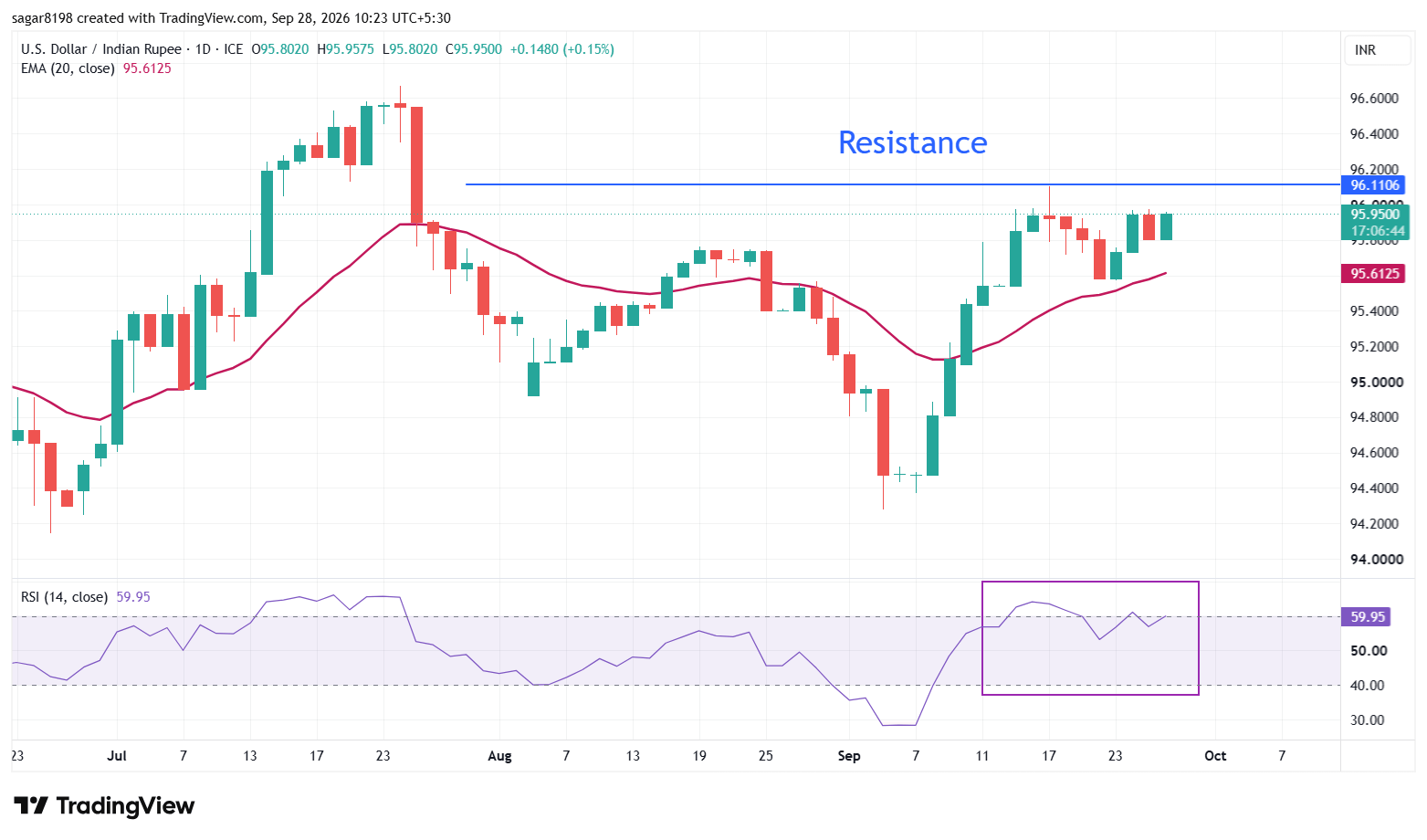
In the daily chart, USD/INR trades at 95.95, holding above the 20-period exponential moving average (EMA) at 95.61, which keeps the near-term bias bullish. The recent recovery from sub-95.00 levels is supported by a Relative Strength Index (RSI) at 56.7, suggesting constructive but not overextended momentum as the pair consolidates near recent highs.
On the downside, immediate support is seen at the 20-day EMA around 95.61, which protects the advance and would need to give way to signal a deeper corrective phase. Looking up, the 96.10 is the immediate hurdle for the pair.
(The technical analysis of this story was written with the help of an AI tool. Know more.)
Indian Rupee FAQs
The Indian Rupee (INR) is one of the most sensitive currencies to external factors. The price of Crude Oil (the country is highly dependent on imported Oil), the value of the US Dollar – most trade is conducted in USD – and the level of foreign investment, are all influential. Direct intervention by the Reserve Bank of India (RBI) in FX markets to keep the exchange rate stable, as well as the level of interest rates set by the RBI, are further major influencing factors on the Rupee.
The Reserve Bank of India (RBI) actively intervenes in forex markets to maintain a stable exchange rate, to help facilitate trade. In addition, the RBI tries to maintain the inflation rate at its 4% target by adjusting interest rates. Higher interest rates usually strengthen the Rupee. This is due to the role of the ‘carry trade’ in which investors borrow in countries with lower interest rates so as to place their money in countries’ offering relatively higher interest rates and profit from the difference.
Macroeconomic factors that influence the value of the Rupee include inflation, interest rates, the economic growth rate (GDP), the balance of trade, and inflows from foreign investment. A higher growth rate can lead to more overseas investment, pushing up demand for the Rupee. A less negative balance of trade will eventually lead to a stronger Rupee. Higher interest rates, especially real rates (interest rates less inflation) are also positive for the Rupee. A risk-on environment can lead to greater inflows of Foreign Direct and Indirect Investment (FDI and FII), which also benefit the Rupee.
Higher inflation, particularly, if it is comparatively higher than India’s peers, is generally negative for the currency as it reflects devaluation through oversupply. Inflation also increases the cost of exports, leading to more Rupees being sold to purchase foreign imports, which is Rupee-negative. At the same time, higher inflation usually leads to the Reserve Bank of India (RBI) raising interest rates and this can be positive for the Rupee, due to increased demand from international investors. The opposite effect is true of lower inflation.
Nothing in this material constitutes investment advice, personal recommendation, investment research, an offer, or a solicitation to buy or sell any financial instrument. The content has been prepared without consideration of your individual investment objectives, financial situation, or needs, and should not be treated as such.
Past performance is not a reliable indicator of future performance and/or results. Forward-looking scenarios or forecasts are not a guarantee of future performance. Actual results may differ materially from those anticipated.
Mitrade makes no representation or warranty as to the accuracy or completeness of the information provided and accepts no liability for any loss arising from reliance on such information.
Recommended Articles


