



Yen stalls at 160.00 on Tokyo's warning ahead of Japan's growth data
- USD/JPY touches 160.00 for the first time since early September, then stalls.
- Tokyo calls the Yen's moves too rapid as US 10-year yields rise past 5%.
- US producer prices are due Friday, with Japan's growth figures on Sunday.
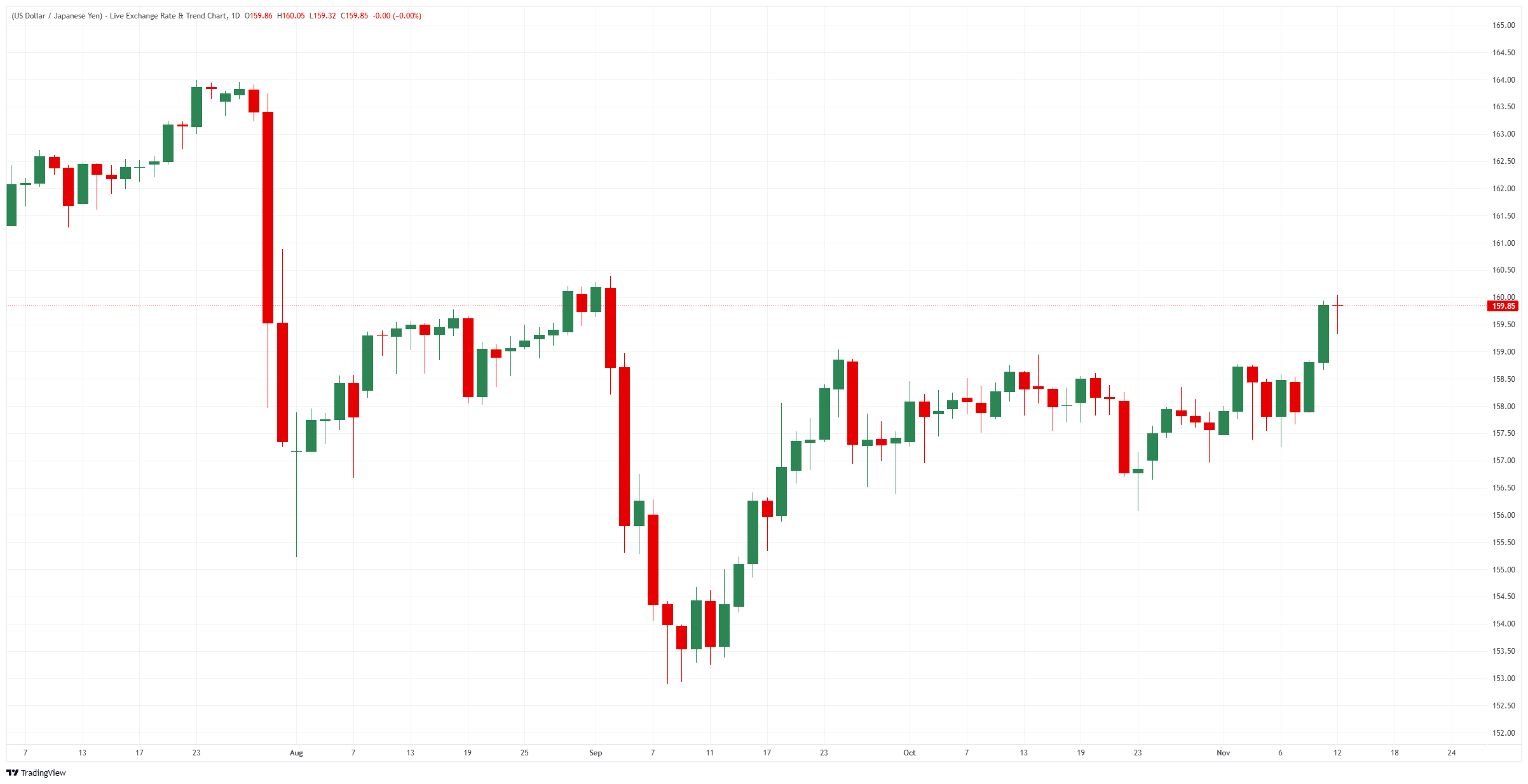
The 160.00 level, where Japan has bought Yen twice this year, was reached on Thursday for the first time since early September, and USD/JPY didn't stay above it. The session high was just over the level and the pair is trading just under it, almost exactly where it started. Wednesday's jump out of its range was the last move of any size.
Japan's Vice Finance Minister for International Affairs Mimura said on Thursday that recent moves were too rapid and that the summer's intervention shouldn't be forgotten. Japan spent a record JPY 15.4 trillion from July 30 to August 3, and the New York Fed confirmed on Thursday that the US Treasury bought Yen in the third quarter. That operation took the pair from near 164.00 to near 155.00, and it's now within about four Yen of where it began.
A Fed hike on December 9 is fully priced, and the 10-year Treasury yield rose to about 5.12% on Thursday after weak demand at a 30-year auction. The Dollar gained on the Euro, the Pound and the Kiwi. The Bank of Japan (BoJ) rate is 1.25% against the Fed's 3.75%-4.00%, and USD/JPY was the pair that didn't move.
On the calendar
New York Fed President Williams speaks at 23:30 GMT on Thursday. Friday's US producer price release at 13:30 GMT is forecast to show a 0.4% monthly rise after 1.3%, which bears on how large the Fed's December hike is.
Japan's preliminary third-quarter Gross Domestic Product (GDP) is due at 23:50 GMT on Sunday, forecast up 0.1% on the quarter after 0.4%. BoJ board member Takata, who voted for a hike on October 30, speaks at 04:00 GMT on Monday, and October national inflation follows at 23:30 GMT on Thursday, November 19. All three come before the BoJ's December 18 decision, where a hike is widely expected.
On the charts
Wednesday's rise broke the pair out of the 157.00-159.00 band that had held it since late September. It has now recovered about three-fifths of the fall from the late-July high to the September low near 153.00. Thursday's bar is a narrow one, with a low just under 159.50 and its first and latest prices almost identical.
USD/JPY daily chart
Japanese Yen FAQs
The Japanese Yen (JPY) is one of the world’s most traded currencies. Its value is broadly determined by the performance of the Japanese economy, but more specifically by the Bank of Japan’s policy, the differential between Japanese and US bond yields, or risk sentiment among traders, among other factors.
One of the Bank of Japan’s mandates is currency control, so its moves are key for the Yen. The BoJ has directly intervened in currency markets sometimes, generally to lower the value of the Yen, although it refrains from doing it often due to political concerns of its main trading partners. The BoJ ultra-loose monetary policy between 2013 and 2024 caused the Yen to depreciate against its main currency peers due to an increasing policy divergence between the Bank of Japan and other main central banks. More recently, the gradually unwinding of this ultra-loose policy has given some support to the Yen.
Over the last decade, the BoJ’s stance of sticking to ultra-loose monetary policy has led to a widening policy divergence with other central banks, particularly with the US Federal Reserve. This supported a widening of the differential between the 10-year US and Japanese bonds, which favored the US Dollar against the Japanese Yen. The BoJ decision in 2024 to gradually abandon the ultra-loose policy, coupled with interest-rate cuts in other major central banks, is narrowing this differential.
The Japanese Yen is often seen as a safe-haven investment. This means that in times of market stress, investors are more likely to put their money in the Japanese currency due to its supposed reliability and stability. Turbulent times are likely to strengthen the Yen’s value against other currencies seen as more risky to invest in.
Nothing in this material constitutes investment advice, personal recommendation, investment research, an offer, or a solicitation to buy or sell any financial instrument. The content has been prepared without consideration of your individual investment objectives, financial situation, or needs, and should not be treated as such.
Past performance is not a reliable indicator of future performance and/or results. Forward-looking scenarios or forecasts are not a guarantee of future performance. Actual results may differ materially from those anticipated.
Mitrade makes no representation or warranty as to the accuracy or completeness of the information provided and accepts no liability for any loss arising from reliance on such information.
Recommended Articles


