



Ripple Price Forecast: XRP bulls build new support base amid RLUSD payments expansion
- XRP reclaims the 100-day EMA as short-term support but could face an uphill recovery.
- Ripple partners with Cross River Bank to integrate RLUSD on the XRP Ledger for enhanced stablecoin payments.
- XRP upside appears capped by both the 50-day and 200-day EMAs, while a MACD sell signal dampens recovery potential.
Ripple (XRP) ticks up for the second day in a row on Friday, trading at $1.34. The remittance token holds above medium-term structural support; however, strong supply near $1.40 caps upside.
A break above this area would reinforce the bullish grip. On the downside, a break below $1.30 could accelerate the sell-off toward key psychological levels at $1.20 and $1.00, respectively.
Ripple deepens stablecoin payments as Cross River integrates RLUSD
Cross River Bank, a technology infrastructure platform providing financial solutions, has entered into a strategic partnership with Ripple to integrate RLUSD, a US Dollar-backed stablecoin, into the company’s Core Operating System (COS). The integration taps the XRP Ledger (XRPL) to converge traditional banking and blockchain-based payments within the regulated United States (US) financial system.
“By combining traditional payment technology with RLUSD on the XRPL, Cross River and Ripple are enabling a new settlement option for payment networks, giving issuers and acquirers greater flexibility to settle intraday and reduce settlement latency,” Cross River press release said.
The partnership allows Cross River to support RLUSD payments and integrate stablecoin payments across its institutional-facing platform, thus establishing a new payment rail. Additionally, the integration enables businesses to use stablecoin programmability and near-instant settlement with 24/7 access.
Technical analysis: XRP rises amid dip buying
XRP hovers above $1.34 as bulls take on more risk following the latest correction near $1.30. The token also holds just above the 100-day Exponential Moving Average (EMA) at $1.34 but remains capped by longer-term trend filters. The 200-day EMA at $1.38 and the 50-day EMA at $1.39 sit overhead as a layered resistance band, suggesting rallies remain vulnerable while the pair fails to reclaim these medium- and long-term averages.
Momentum stays soft, as the Moving Average Convergence Divergence (MACD) indicator remains below zero, while the Relative Strength Index (RSI) at 40 hovers below the midline, hinting at lingering downside pressure rather than a decisive bullish turn.
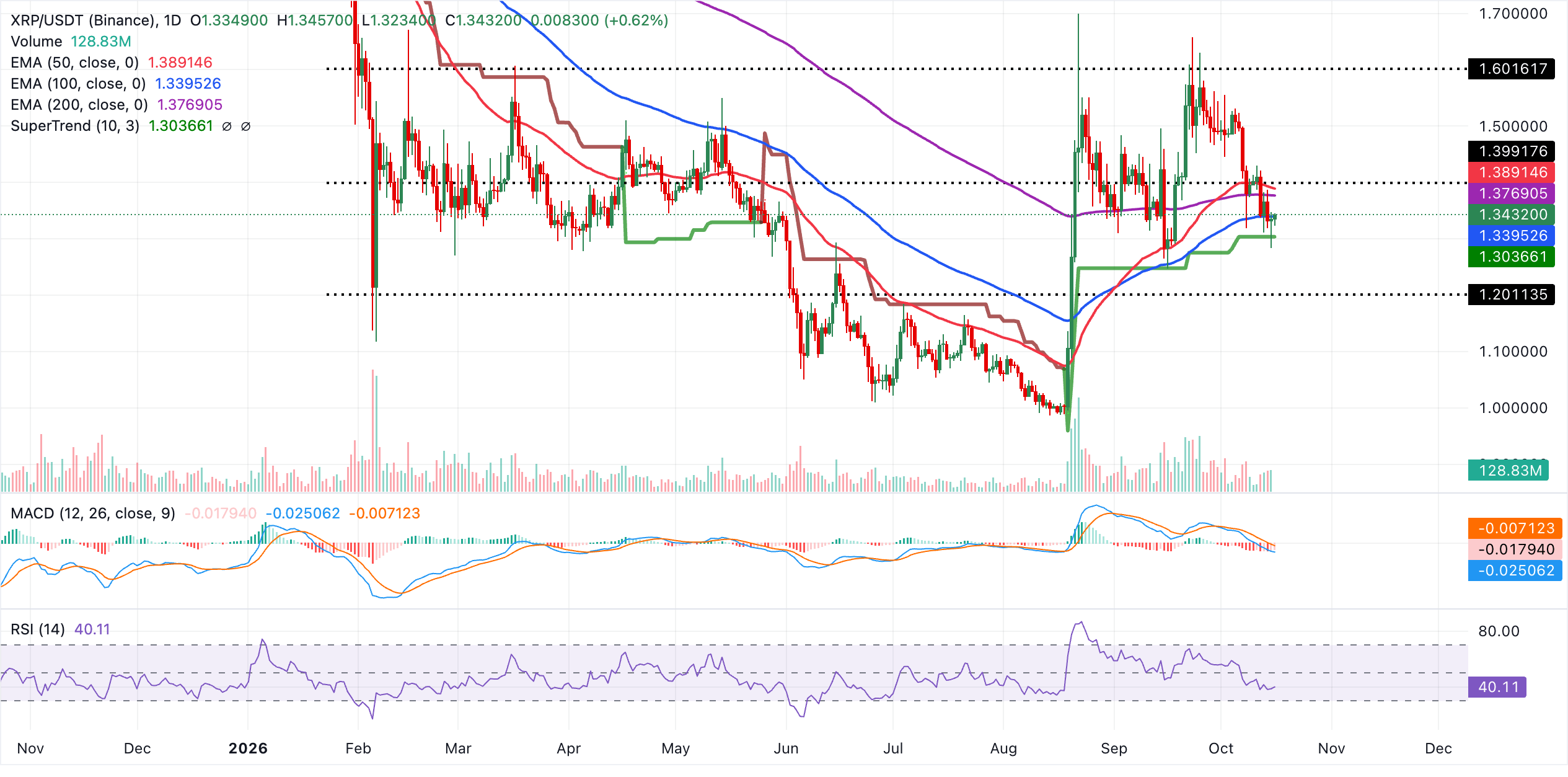
Initial resistance lies at the SuperTrend line near $1.30, with a more meaningful barrier at the 200-day EMA at $1.37, followed by the 50-day EMA at $1.39, which would need to be cleared to shift the broader tone back to constructive. On the downside, the 100-day EMA at $1.34 provides immediate support, and a sustained break below this floor would likely expose XRP to further selling, in line with the still-negative MACD backdrop and the sub-50 RSI reading.
(The technical analysis of this story was written with the help of an AI tool. Know more.)
Ripple FAQs
Ripple is a payments company that specializes in cross-border remittance. The company does this by leveraging blockchain technology. RippleNet is a network used for payments transfer created by Ripple Labs Inc. and is open to financial institutions worldwide. The company also leverages the XRP token.
XRP is the native token of the decentralized blockchain XRPLedger. The token is used by Ripple Labs to facilitate transactions on the XRPLedger, helping financial institutions transfer value in a borderless manner. XRP therefore facilitates trustless and instant payments on the XRPLedger chain, helping financial firms save on the cost of transacting worldwide.
XRPLedger is based on a distributed ledger technology and the blockchain using XRP to power transactions. The ledger is different from other blockchains as it has a built-in inflammatory protocol that helps fight spam and distributed denial-of-service (DDOS) attacks. The XRPL is maintained by a peer-to-peer network known as the global XRP Ledger community.
XRP uses the interledger standard. This is a blockchain protocol that aids payments across different networks. For instance, XRP’s blockchain can connect the ledgers of two or more banks. This effectively removes intermediaries and the need for centralization in the system. XRP acts as the native token of the XRPLedger blockchain engineered by Jed McCaleb, Arthur Britto and David Schwartz.
Nothing in this material constitutes investment advice, personal recommendation, investment research, an offer, or a solicitation to buy or sell any financial instrument. The content has been prepared without consideration of your individual investment objectives, financial situation, or needs, and should not be treated as such.
Past performance is not a reliable indicator of future performance and/or results. Forward-looking scenarios or forecasts are not a guarantee of future performance. Actual results may differ materially from those anticipated.
Mitrade makes no representation or warranty as to the accuracy or completeness of the information provided and accepts no liability for any loss arising from reliance on such information.
Recommended Articles


