



McDonald's (MCD.US): Beyond the Crowded AI Trade, Is the Cheapest McDonald's in Five Years Worth Buying?
As the market continues to pay a premium for computing power, investors can also revisit a discounted cash-flow machine.
The main theme of the U.S. stock market in 2026 remains dominated by AI. Outside the crowded tech trade, McDonald's (MCD.US) is showing increasingly prominent asset allocation value: its earnings do not depend on a single capex cycle, but stem from top-line sales, high-margin rents, and royalties across more than 45,000 restaurants globally.
As of August 25, 2026, McDonald's closed at $268.10, down about 12.3% year-to-date and off 21.5% from its March high ($341.75). Its current trailing P/E ratio is around 21.9x and forward P/E is about 20.5x, approximately 17% and 15% below their five-year averages, respectively, placing them near five-year valuation lows.
Our core take: The current discount reflects real pressures on consumer spending, execution, and interest rates. However, store expansion, franchise profits, and dividend growth are continuing, and the risk-reward ratio has significantly improved. For investors seeking to reduce AI concentration with a three-to-five-year holding horizon, the area around $268 offers a viable entry point for building positions in tranches.
I. McDonald's Superior Business Model: The World's Largest Fast-Food Empire Powered by a Franchise and Real Estate Network
By the end of 2025, franchised locations accounted for roughly 95% of McDonald's 45,000+ global stores, while company-operated stores (about 5%) primarily serve R&D and testing functions for standardized processes.
After consumers pay for meals at stores, franchisees first cover the costs of ingredients, labor, utilities, and other operating expenses. McDonald's corporate provides the brand, menu, supply chain, marketing, and a complete operating system, continuously generating two streams of revenue from franchisee sales:
- Rent. Under the traditional franchise model, McDonald's typically owns the store's land and building or holds long-term lease rights, leasing the property to franchisees. Franchisees pay base rent, and some contracts include variable rent tied to sales volume.
- Royalties. Franchisees pay corporate a percentage of store sales for using McDonald's brand and operating system. This can also be understood as an ongoing "brand royalty fee."
By the end of 2025, McDonald's owned approximately 56% of restaurant land and 80% of restaurant buildings in consolidated markets. Real estate ownership enhances the stability of franchise relationships and enables corporate to maintain long-term control over site selection, store standards, and network layout.
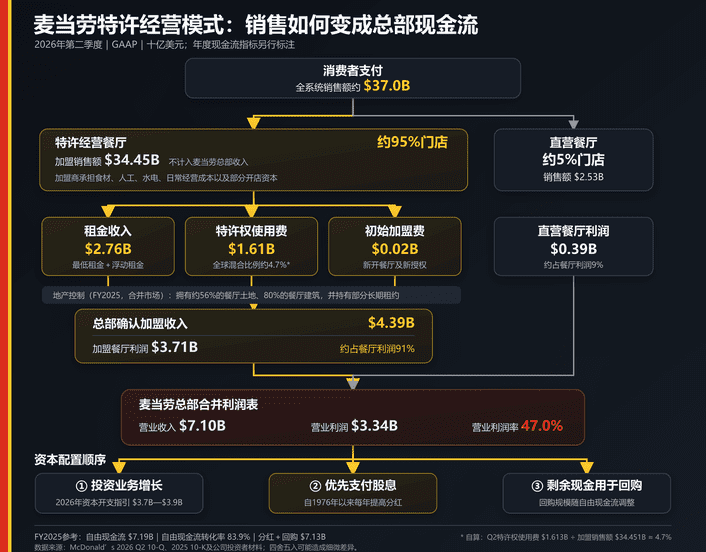
Figure 1: McDonald's Core Business Model and Cash Flow Structure, compiled by TradingKey
The advantages of this business model can be summarized in four points:
- Smaller store-level cost volatility borne by corporate: Corporate takes a cut of top-line sales, while labor, ingredient, and utility costs are absorbed first by franchisees, minimizing the direct impact on corporate's current income statement.
- Provides a cushion against inflation: The rental structure covers "minimum rent + percentage rent." Menu price increases directly boost corporate's nominal revenues.
- Network expansion funded by third-party capital: Franchisees are typically responsible for equipment, staffing, working capital, and part of the investments for new store developments, allowing corporate to leverage franchisee capital to expand the network with higher capital efficiency.
- Exceptionally high profit margins and free cash flow conversion: In Q2 2026, franchised restaurant margin reached $3.713 billion, representing about 91% of total restaurant margins and helping the company maintain an operating margin of approximately 47%.
II. Where Is the Future Growth Story?
1. Store Expansion Sets the Floor for Growth
McDonald's expects to open approximately 2,600 new restaurants in 2026, translating to a net addition of about 2,100 stores after closures. The company projects that net new stores will contribute roughly 2.5 percentage points to systemwide sales growth in 2026.
More than 1,800 new stores will be funded by developmental licensees and affiliates, with incremental growth mainly coming from International Developmental Licensed (IDL) markets—such as China, Japan, and Brazil across over 75 markets operated primarily by local developmental licensees or affiliates. Local partners cover store investments and operations, while McDonald's mainly collects royalties based on sales, with certain affiliates also contributing equity in earnings. As a result, McDonald's can expand its network with relatively limited corporate capital while continuously collecting royalties.
Notably, the latest guidance pushes the target of 50,000 global stores to 2028, one year later than the previously stated 2027 goal. UBS noted that the company postponed the target by a year to prioritize return on new store openings in an environment of inflation and consumer spending headwinds.
2. Guest Traffic and Frequency Determine Growth Quality
As of Q2 2026, McDonald's had nearly 220 million 90-day active loyalty members across 70 loyalty markets, a 13% year-over-year increase, with the app serving as the primary entry point. Over the past 12 months, loyalty members contributed $40 billion in systemwide sales, growing by over 20% year-over-year.
Product innovation creates new reasons to visit. McDonald's global core menu contributes over 60% of sales, leading the company to continue investing around chicken, beef, and beverages. The chicken market is roughly twice the size of beef and is growing faster; McDonald's plans to expand its share via products like McCrispy and McSpicy, while enhancing beef competitiveness through "Best Burger" initiatives and the Big Arch.
Beverages offer a noteworthy new occasion. The company is expanding McCafé from a traditional coffee brand into a broader beverage platform spanning cold coffee, fruity refreshers, specialty sodas, and energy drinks. The goal is to address breakfast, afternoon pick-me-up, and snacking occasions, giving consumers an additional standalone reason to visit. Beverage tests across more than 500 U.S. restaurants performed better than expected, and 2026 new product rollouts have begun expanding across the U.S. and select international markets.
Value propositions protect baseline traffic. McDonald's is reinforcing everyday low price items, value meals, limited-time offers, and digital discounts to help budget-conscious consumers view McDonald's once again as an affordable dining choice.
III. Why Has the Stock Fallen 12.3% Year-to-Date?
As of August 25, 2026, McDonald's stock closed at $268.10, down roughly 12.3% year-to-date and 21.5% below its March high of $341.75. The core driver is a dual market re-rating of both business fundamentals and valuation.
1. The Traditional Trade-Down Logic Is Failing
McDonald's has long been viewed as a beneficiary of trade-down behavior. During economic slowdowns, consumers cut back on higher-priced dining out and shift to lower-cost fast food, allowing McDonald's to capture additional guest traffic.
However, in 2026, this dynamic failed to drive expected traffic to McDonald's. A consumer survey by FMI showed that 70% of respondents felt their income had not kept pace with inflation; about half reduced restaurant, takeout, and delivery spending, 44% ate more at home, and 35% cooked for themselves more frequently. The Federal Reserve's March Beige Book also noted that in the Atlanta Fed district covering the Southeastern U.S., food, energy, and medical expenses were squeezing household budgets, prompting some consumers to eliminate dining out entirely.
McDonald's operating metrics reflected these traffic pressures: U.S. comparable store sales grew 3.9% in Q1 2026, driven primarily by average check size, while growth slowed to 0.8% in Q2 2026 as guest counts continued to decline. Global comparable sales also decelerated from 3.8% to 1.3%. The trade-down benefit did not translate into guest traffic for McDonald's as anticipated, which is the shift troubling the market.
2. McDonald's Faced Internal Operational Missteps
The guest traffic decline in Q2 2026 also stemmed from internal execution issues:
- Inconsistent implementation of value menus. Roughly one-third of the U.S. franchise system did not follow corporate pricing guidance, and consumer awareness of the new menu fell below target. Differing prices for the same deal across different stores diluted the impact of national value marketing.
- Cluttered product initiatives in a single quarter. McDonald's launched brand collaboration meals, value menus, specialty beverages, and World Cup marketing promotions in rapid succession. Stores were forced to handle new products, equipment, and workflows simultaneously, leading to longer service times and damaged customer satisfaction.
3. High Interest Rates Reshaped Valuation Metrics for Defensive Stocks
As of August 25, the U.S. 10-year Treasury yield stood at 4.64%, with the 30-year yield reaching 5.17%. At its July meeting, the Federal Reserve maintained the federal funds target rate range at 3.50% to 3.75%.
Based on a stock price of $268.10 and an annualized dividend of $7.44, McDonald's current dividend yield is approximately 2.78%, which is 1.86 percentage points lower than the 10-year Treasury yield.
This implies that from a current cash-yield perspective alone, holding McDonald's requires investors to accept a lower yield alongside higher price volatility. McDonald's must rely on earnings growth, dividend growth, and potential capital appreciation to make up the yield spread relative to risk-free assets.
IV. Is the Current Stock Price Truly Cheap?
Compared with Historical Averages: Entering an Attractive Entry Range
According to S&P Global Market Intelligence consensus estimates as of August 25, 2026, McDonald's EPS is projected at approximately $12.94 for 2026, representing a P/E of 20.7x, and $13.96 for 2027, representing a P/E of 19.2x.
Valuation Metric | Current | 5-Year Average or Median | Discount vs. 5-Year Average |
Trailing P/E | 21.9x | 26.5x | Approx. 17% |
Forward P/E | 20.5x | 24.0x | Approx. 15% |
EV/EBITDA | 16.6x | 19.4x | Approx. 14% |
P/FCF | 25.1x | 30.1x | Approx. 17% |
Note: Trailing and forward P/E ratios are sourced from Morningstar; EV/EBITDA and P/FCF are from TGMCharts, with slight differences in data dates. Morningstar and S&P Global Market Intelligence use different earnings estimate methodologies, resulting in minor variances in forward P/E ratios.
All four main valuation metrics are roughly 14% to 17% below their five-year averages, indicating that the market has stripped away a significant portion of the company's quality premium. While McDonald's is not yet cheap enough to buy blindly, its current valuation is attractive enough to support building positions in phases for a defensive company featuring stable cash flows, consistent dividend increases, and mid-single-digit earnings growth potential.
Compared with Bonds: Not Extremely Cheap, but Attractive for Asset Allocation
Metric | Current Level |
Stock Price | $268.10 |
2027 Forward P/E | 19.2x |
2027 Projected Earnings Yield | Approx. 5.2% |
Dividend Yield | Approx. 2.78% |
10-Year Treasury Yield | 4.64% |
Earnings Yield Spread vs. 10-Yr Treasury | Approx. 0.6 percentage points |
Dividend Yield Spread vs. 10-Yr Treasury | Approx. -1.86 percentage points |
Against a 4.64% risk-free rate, a P/E ratio of around 20x is not an extreme bargain. However, while bonds pay a fixed coupon, McDonald's offers expanding earnings and growing dividends. As long as the company maintains 5% to 7% EPS growth, current valuations can still offer long-term investors higher potential total returns than bonds.
High interest rates may continue to limit short-term valuation expansion, which is a primary reason the stock has entered a consolidation range. However, for investors planning to hold for three to five years, price chop provides time to accumulate shares in tranches rather than a signal to avoid the stock.
Three Valuation Scenarios
The following 12-month scenario valuations utilize 2027 EPS estimates, adjusting both operational assumptions and valuation multiples across scenarios.
Scenario | Operational Assumptions | 2027 EPS | P/E | Target Price | Upside/Downside | Est. Total Return (incl. ~1 yr div) |
Bear Case | Negative U.S. traffic persists, promo efficiency stays low, new store returns face pressure | $13.20 | 18.0x | $238 | -11.2% | Approx. -8% to -9% |
Base Case | Traffic stabilizes gradually, store expansion proceeds as planned, margins remain steady | $13.96 | 21.1x | $294 | +9.7% | Approx. 12% to 13% |
Bull Case | U.S. traffic turns positive, loyalty and menu innovation drive frequency, interest rates fall | $14.50 | 23.0x | $334 | +24.6% | Approx. 27% |
We believe the Base Case is the most likely scenario to play out.
While U.S. traffic remains under near-term pressure, McDonald's issues stem partly from promotional, pricing, and operational missteps—problems far easier to remedy than permanent brand impairment. At the same time, global store expansion is forging ahead, franchise profits are growing, and dividends continue to rise, providing a solid floor for earnings.
Consequently, the stock is more likely to consolidate in the short term to digest traffic and interest-rate pressures before moving toward the $294 base-case target as operating metrics stabilize. The Bull Case requires both positive U.S. traffic and falling interest rates, so it should not be the primary expectation for now; the Bear Case assumes traffic issues deteriorate into a structural crisis, for which evidence remains insufficient.
Our assessment is clear: around $268 is a suitable level to begin building positions. If the stock pulls back further to $240–$250, the risk-reward ratio becomes even more compelling.
V. Investment Drivers Beyond Low Valuation
1. Earnings Growth Delivers Baseline Returns, Traffic Recovery Adds Upside
Based on consensus estimates used in this analysis, McDonald's EPS is expected to grow from $12.94 in 2026 to $13.96 in 2027, representing a year-over-year increase of about 7.9%. Growth is driven primarily by store expansion, low-single-digit comparable store sales, and franchise profit expansion, with net new stores projected to contribute roughly 2.5 percentage points to 2026 systemwide sales growth.
If future EPS maintains a 5% to 7% growth pace, combined with the current ~2.78% dividend yield, investors could achieve an annualized baseline return of roughly 8% to 10% even without valuation multiple expansion. A turn to positive U.S. guest traffic or a drop in long-term Treasury yields could further catalyze earnings upgrades and valuation re-ratings.
2. Consistent Dividend Growth Provides Cash Returns
In 2025, McDonald's generated $7.19 billion in free cash flow and returned $7.13 billion to shareholders through dividends and buybacks, returning virtually all of its full-year FCF to investors. In the first half of 2026, company-calculated FCF reached approximately $3.71 billion, with $2.64 billion spent on dividends and $1.25 billion on share repurchases. FCF covered dividends by about 1.4x; including buybacks, overall capital return coverage stood at roughly 95%.
McDonald's has raised its dividend every year since 1976. The current annualized dividend is $7.44, with an estimated payout ratio of about 57.5%, which comfortably supports mid-single-digit dividend growth. Compared with fixed-coupon Treasuries, McDonald's provides a cash stream that grows alongside earnings over time.
3. Diversified Return Source for AI-Heavy Portfolios
For investors already holding heavy technology exposures, McDonald's allocation value manifests in two key ways:
- Mitigating single-theme concentration risk. Reduces portfolio exposure to tech capex cycles, growth valuations, and mega-cap concentration;
- Dampening overall market volatility sensitivity. McDonald's 60-month beta is approximately 0.41, indicating historical price sensitivity well below market averages. Steady franchised cash flows and growing dividends also serve to smooth portfolio volatility.
VI. Key Investment Risks to Watch
- U.S. traffic slowdown turning structural: Guest traffic remained softer than expected despite value launches. The company faces a dilemma: deeper discounts erode margins, while fewer deals lose customers. Post-promotional customer retention will be critical to monitor.
- Cost inflation eroding franchisee profitability: Labor and ingredient inflation directly squeeze franchisee income statements (U.S. company-operated restaurant margin dollars fell 14% year-over-year in 1H26). Deteriorating franchisee cash flow could lead to reduced CAPEX and slower store openings, ultimately weighing on corporate royalties.
- Aggressive expansion triggering return dilution and cannibalization: The company plans a net addition of 2,100 stores in 2026 (with CAPEX rising to $3.7–$3.9 billion), though the 50,000-store goal has been pushed back to 2028. Excessive store density risks cannibalizing existing locations; evaluations should focus on store-level returns rather than sheer store count.
- GLP-1 weight-loss drug penetration weighing on terminal valuation: Research indicates fast-food spending drops by an average of ~8% within six months of GLP-1 adoption in households. Rising adoption poses a structural risk to consumption frequency and caloric intake for fast food, capping long-term terminal valuations.
Investment Summary & Conclusion: Consolidation Offers an Entry Window, Not an Exit Signal
McDonald's currently trades at roughly 19.2x 2027 forward EPS, representing a ~15% discount to its historical valuation. High interest rates and U.S. traffic declines may continue to cap near-term performance, making an immediate sharp rebound unlikely and consolidation within the current range more probable.
However, the core pillars supporting McDonald's long-term value remain intact. Store expansion continues to drive top-line growth, EPS and dividends are steadily increasing, and U.S. promotional and execution missteps are highly fixable. As guest traffic stabilizes, the market is poised to re-assign a higher quality valuation premium to McDonald's.
Conclusion: Based on publicly available information, we maintain a positive medium-to-long-term outlook on McDonald's. The market is discounting a long-term cash-flow machine over short-term traffic headwinds, even though store expansion, dividend growth, and franchise earnings fundamentals remain intact. While the stock may continue to consolidate, this represents a buying opportunity rather than an exit signal. For long-term investors, the optimal strategy is to hold existing positions, accumulate on dips, and add further exposure once operational recovery is confirmed.
Disclaimer: The analysis in this article represents a research framework based solely on existing publicly available information and does not constitute investment advice.
Nothing in this material constitutes investment advice, personal recommendation, investment research, an offer, or a solicitation to buy or sell any financial instrument. The content has been prepared without consideration of your individual investment objectives, financial situation, or needs, and should not be treated as such.
Past performance is not a reliable indicator of future performance and/or results. Forward-looking scenarios or forecasts are not a guarantee of future performance. Actual results may differ materially from those anticipated.
Mitrade makes no representation or warranty as to the accuracy or completeness of the information provided and accepts no liability for any loss arising from reliance on such information.
Recommended Articles


