



This Space Stock Gained Over 37% in August, Beating SpaceX, LUNR, and RKLB as BofA Sees 34% Upside
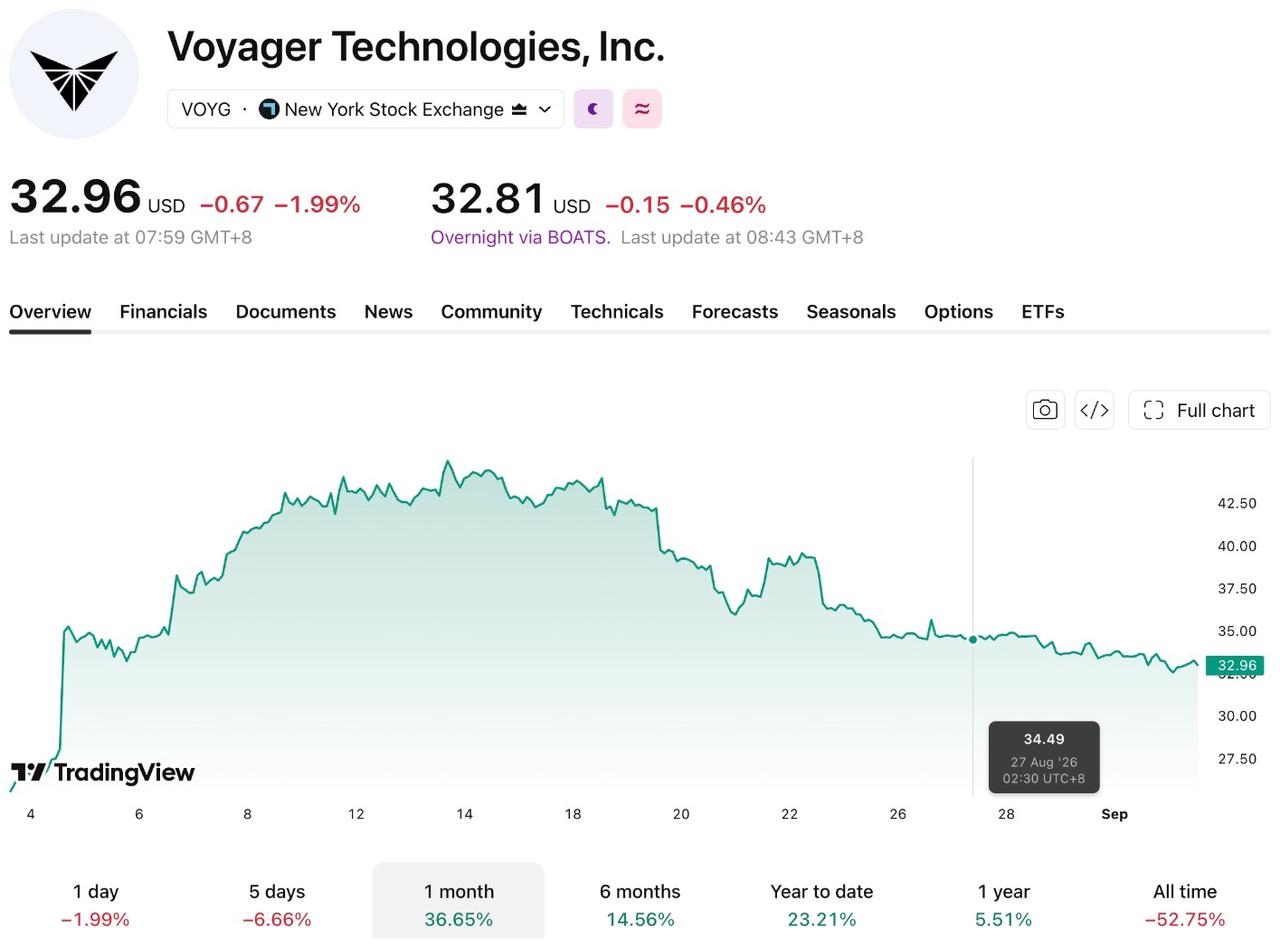
TradingKey - Stock prices of major global space companies diverged significantly in August. Voyager Technologies (VOYG) surged about 37%, leading the gains; SpaceX (SPCX) rose about 33%; Intuitive Machines (LUNR) gained about 25%; AST SpaceMobile (ASTS) rose by only 0.2%; while Rocket Lab (RKLB) fell about 2%.
[Source: TradingView]
Why Is Voyager Stock Rising?
The momentum behind Voyager's stock rally was mainly driven by defense orders and its lunar business. Of the new orders in the second quarter, $84.3 million was related to U.S. "Golden Dome" missile defense projects, involving multiple customers, programs, and technology platforms.
Subsequently, the company secured a U.S. Space Force satellite communications contract as well as supporting orders for Raytheon's SM-3 missile propulsion system. These orders significantly boosted Voyager's revenue share in defense and national security, while bolstering market expectations for its business sustainability.
Meanwhile, Voyager completed its acquisition of Astrobotic in a deal with an enterprise value of approximately $300 million.
Astrobotic adds operational capabilities to Voyager in areas such as lunar surface delivery, mobility platforms, infrastructure construction, autonomous systems, and advanced robotics. The company expects Astrobotic to contribute approximately $40 million to $50 million in revenue during the remainder of 2026, which is expected to help Voyager reach overall profitability sooner.
Defense orders and the lunar business currently constitute Voyager's two major growth pillars. Over the long term, as NASA and commercial customers continue to increase investment in lunar infrastructure, Astrobotic's business will complement the defense segment, jointly supporting Voyager's diversified revenue structure in the space economy.
Orders Surge, But Profit Pressure Persists
Voyager reported its second-quarter results on August 3. The company generated $52.7 million in revenue for the quarter, up 51% quarter-over-quarter and approximately 15% year-over-year, while quarterly bookings reached a record high of $113 million. The company subsequently raised its full-year 2026 revenue guidance from $230 million–$255 million to $275 million–$305 million, representing year-over-year growth of 66% to 84%.
However, high growth has not simultaneously translated into profitability. The company posted an adjusted EBITDA loss of approximately $37.5 million in the second quarter, with management stating that 2026 remains an investment phase with substantial spend in R&D, engineering, manufacturing capabilities, and production infrastructure. The company expects internal R&D expenditure to account for roughly 20% of full-year revenue.
This means that Voyager's primary challenge currently remains the gap between rapid growth in bookings and revenue versus its profitability. What the market needs to see is not just contract values, but the speed of revenue recognition, gross margin improvement, and narrowing losses.
Peer Performance: Rocket Lab and Intuitive Machines
High order growth accompanied by widening losses is not unique to Voyager. Sector peers Rocket Lab and Intuitive Machines exhibited similar characteristics in their quarterly results released in August.
Rocket Lab reported second-quarter results on August 10, with revenue of approximately $234 million, up 62% year-over-year and beating market expectations. However, adjusted loss per share was 8 cents, wider than the market expectation of around 6 cents. Following the report, the stock fell over 6% in after-hours trading at one point, as market disappointment over bottom-line performance outweighed the positive revenue surprise.
Intuitive Machines reported second-quarter results on August 13, with revenue of approximately $206 million, up about 310% year-over-year but below market expectations, alongside an adjusted EBITDA loss of roughly $13.8 million.
The stock dropped significantly following the report but recovered quickly, mainly as order growth regained market focus with the backlog for the quarter increasing to approximately $1.8 billion.
The results from Rocket Lab and Intuitive Machines indicate a common characteristic across the space sector: orders are accumulating rapidly, but profits have been slow to keep pace. Market enthusiasm for contract values has begun to cool, giving way to closer scrutiny of profitability execution.
Voyager Wins Bullish Wall Street Support
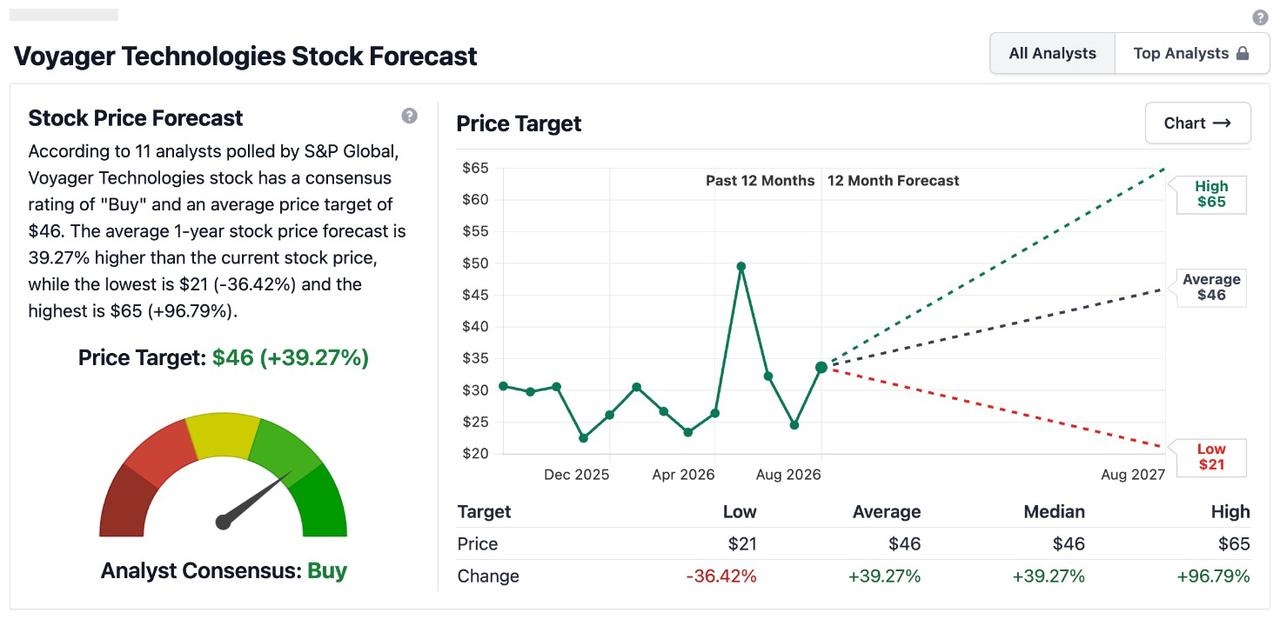
According to StockAnalysis data, as of September 1 Eastern Time, the average 12-month price target for Voyager from 11 analysts is $46, implying an upside potential of approximately 39.27% from the current stock price.
[Source: StockAnalysis]
Bank of America Securities raised its price target on Voyager from $39 to $45 in late August, implying a potential upside of approximately 34%, while maintaining a Buy rating. The upgrade was mainly driven by record quarterly orders, an upwardly revised full-year revenue guidance, and momentum from defense projects such as Golden Dome.
However, views among other institutions are divided. BTIG previously issued a Buy rating and a $55 price target, and Jefferies set its price target as high as $65, whereas Morgan Stanley downgraded the stock to "Underweight" in early August with a $37 price target. Wall Street's core debate is not whether order growth can be sustained, but whether the rapidly expanding orders and project pipeline can ultimately translate into sustainable revenue and profitability.
Summary
From the perspective of institutional price targets, Voyager still has upside potential. Based on the midpoint of full-year 2026 revenue guidance of $290 million and approximately 120 million outstanding shares, the current market capitalization corresponds to a price-to-sales ratio of about 14x, indicating that the current share price already reflects high expectations for future growth.
The space sector as a whole is still in the phase of transitioning from project-based models to large-scale operations. Voyager's recent rally has already priced in the aforementioned multiple favorable factors, but its high-investment state will not change in the short term.
Overall, whether the share price can continue to rise depends primarily on the pace of order execution, revenue growth, and actual progress in narrowing losses.
Nothing in this material constitutes investment advice, personal recommendation, investment research, an offer, or a solicitation to buy or sell any financial instrument. The content has been prepared without consideration of your individual investment objectives, financial situation, or needs, and should not be treated as such.
Past performance is not a reliable indicator of future performance and/or results. Forward-looking scenarios or forecasts are not a guarantee of future performance. Actual results may differ materially from those anticipated.
Mitrade makes no representation or warranty as to the accuracy or completeness of the information provided and accepts no liability for any loss arising from reliance on such information.
Recommended Articles


