



Meta Shares Surge Over 8% to Highest Since February as Connect 2026 Nears, Muse Agent May Become New AI Variable
TradingKey - Meta Platforms (META)'s annual product event, Meta Connect 2026, will be held on September 23–24 local time. As the company shifts Connect's focus from VR to AI, AR, smart glasses, and the metaverse, the market expects this event to focus on hardware iterations and AI strategic progress.
At the conference, next-generation smart glasses, a lightweight mixed-reality device codenamed "Phoenix", and how AI capabilities integrate into the wearable ecosystem could all be in the spotlight. Driven by expectations surrounding the upcoming conference, Meta's stock price rose over 8% intraday to trade at $721.59, reaching its highest level since early February.
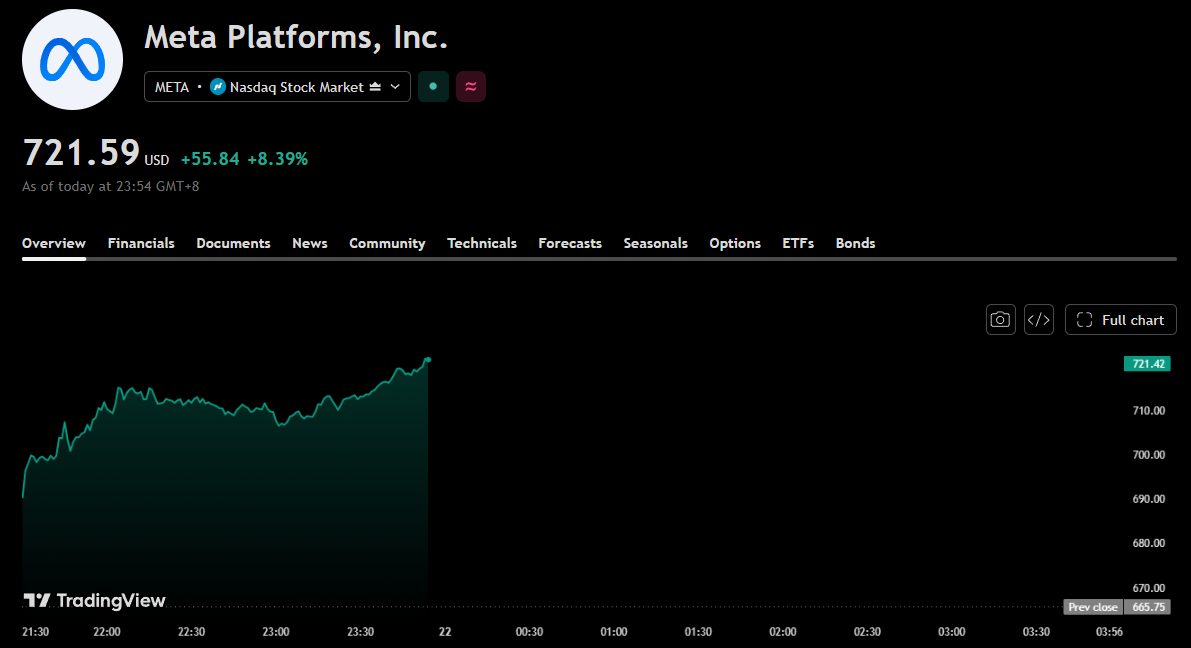
Meta stock price chart, Source: TradingView
Muse Moves from Answering Questions to Executing Tasks
Meta launched Muse on September 8, positioning it as a personal AI agent. Unlike traditional Q&A-focused chatbots, Muse emphasizes completing tasks such as sending emails, booking travel, and filling out forms, with some tasks continuing to run even after users leave the app. Powered by the Muse Spark model, the product is currently being rolled out gradually in the US across iOS, Android, muse.ai, and WhatsApp.
Meta recently released Muse Spark 1.3, further improving performance in long-duration tasks and programming. The market is particularly focused on Muse's support for AI glasses: even if camera-free glasses lack visual input, users can still delegate digital tasks to Muse via voice, thereby providing a clearer use case for wearable devices.
Commercialization Potential Draws Attention
Morgan Stanley believes that agentic AI is shifting from an information lookup tool to an action-oriented assistant capable of searching, comparing, decision-making, and even completing transactions, with potential digital consumer spending reaching approximately $30 trillion. The firm estimates that if Muse reaches 100 million users by 2028, with each user initiating 5 queries per day, 10% of which have commercial value, and Meta earns about $0.07 per commercial query, Muse could contribute approximately $1.3 billion in annual revenue and an incremental $0.35 in earnings per share.
This estimate is highly dependent on user scale, commercial query frequency, and monetization efficiency, and should not be viewed as a baseline forecast. Compared to subscription fees, transaction commissions and behavior-based monetization may represent a larger long-term opportunity for Muse.
Platform Advantages and Industry Revaluation
Morgan Stanley pointed out that Meta's Facebook and Instagram first-party data helps agents understand user preferences, while Apple and Google control operating systems and device entry points. In e-commerce, Amazon, eBay, and Shopify are considered to hold relative advantages, with Shopify helping fragmented merchants adapt to agent-driven product information and transaction workflows.
Travel platforms possess real-time and diversified inventory, remaining defensive in the short term; meanwhile, standardized services such as ride-hailing are more likely to face impacts from price-comparison agents. For Google, if high-commercial-value queries shift toward agentic transactions, unit-transaction monetization of traditional search advertising may come under pressure.
Whether Meta Connect 2026 can form a closed loop connecting Muse, smart glasses, and transaction scenarios will serve as an important window for observing Meta's AI layout and market expectations.
Nothing in this material constitutes investment advice, personal recommendation, investment research, an offer, or a solicitation to buy or sell any financial instrument. The content has been prepared without consideration of your individual investment objectives, financial situation, or needs, and should not be treated as such.
Past performance is not a reliable indicator of future performance and/or results. Forward-looking scenarios or forecasts are not a guarantee of future performance. Actual results may differ materially from those anticipated.
Mitrade makes no representation or warranty as to the accuracy or completeness of the information provided and accepts no liability for any loss arising from reliance on such information.
Recommended Articles


