


Anthropic Shares Drop Over 4% After Jensen Huang Returns to Nvidia: Open-Weight Models May Weaken Claude's Pricing Power
TradingKey - Catalyzed by Jensen Huang's return as CEO of Nvidia (NVDA), the Nasdaq Composite Index rallied strongly by over 6% today. However, just three trading days after its listing, Claude developer Anthropic (ANT) dropped more than 4% at one point to $84.61, sitting just about 2% above its $83 IPO price.
The same news means different things for the two companies' earnings. Jensen Huang's return eased investor concerns over the continuity of Nvidia's strategy, but the open-weight models he has long championed happen to provide Claude's customers with an alternative. Meanwhile, Anthropic's relatively large tradable float in the initial period following its listing also makes its short-term price movements more susceptible to order flows.
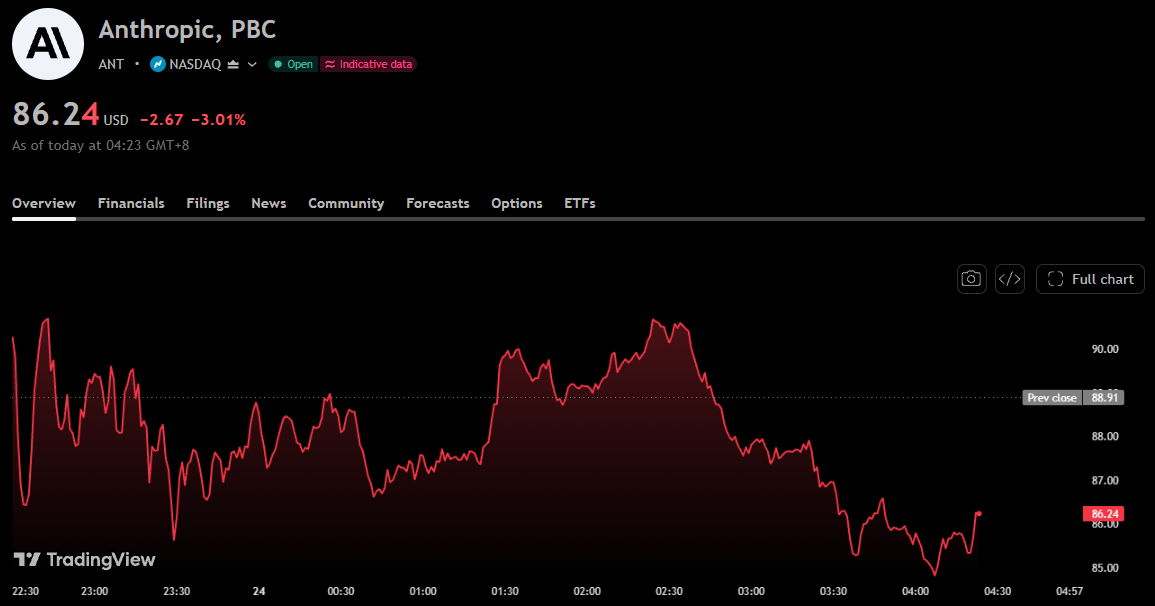
Anthropic stock chart, Source: TradingView
Open-Weight Models Benefit Nvidia Chip Sales but May Weaken Claude's Pricing Power
Nvidia sells GPUs, while Anthropic generates revenue primarily through subscriptions and pay-per-use API calls for Claude. When customers call Claude, they must pay the model provider; opting for open-weights models allows them to download, modify, and deploy models independently within licensing terms, bearing compute and maintenance costs on their own. Both paths require chips, but only the former directly brings model revenue to Anthropic.
According to an analysis by Business Insider, during Jensen Huang's tenure, Nvidia has both developed its own open model, Nemotron, and invested in companies such as Reflection AI, Thinking Machines Lab, and Poolside. For Nvidia, having more customers deploy models on their own is expected to expand GPU demand. For Anthropic, as long as open models meet customer requirements for high-frequency tasks such as document classification and customer service, customers can divert those workloads away and pay Claude's premium only for performance-critical tasks like complex coding.
This also explains why the chip sector rallied on Jensen Huang's return, while Anthropic lacked an equally direct tailwind. Even if compute usage across the industry continues to rise, how much revenue Claude can capture still depends on which tasks customers are willing to entrust to it and how much they are willing to pay for those tasks.
In addition, Anthropic's post-IPO price trajectory shows that newly listed stocks have their own trading rhythms. On November 19, the stock opened at $111.50, well above its $83 offering price, closed its first day at $97.17, and fell to an intraday low of $83.05 the following day. By the time Jensen Huang returned, the first-day premium had narrowed significantly. David Busch, chief investment officer at Trajan Wealth, compared this performance to SpaceX's early days as a public company, noting that such volatility is not uncommon in large IPOs.
However, it should be noted that while Anthropic underperformed the broader market on a single day, it is too early to conclude that open models have siphoned away Claude's customers. In the short term, whether the market can absorb actual selling pressure when lockup expirations occur in December will determine if the stock can stabilize. The longer-term test will appear in its earnings reports: with more options for self-deployment, whether customers remain willing to expand their Claude usage and continue paying for its capabilities in handling complex tasks.
Nothing in this material constitutes investment advice, personal recommendation, investment research, an offer, or a solicitation to buy or sell any financial instrument. The content has been prepared without consideration of your individual investment objectives, financial situation, or needs, and should not be treated as such.
Past performance is not a reliable indicator of future performance and/or results. Forward-looking scenarios or forecasts are not a guarantee of future performance. Actual results may differ materially from those anticipated.
Mitrade makes no representation or warranty as to the accuracy or completeness of the information provided and accepts no liability for any loss arising from reliance on such information.
Recommended Articles


