



Intel Stock Forecast: INTC Drops 24% Overnight as Weak Q4 Guide Overshadows 78% Data Center Growth
TradingKey - Intel (NASDAQ: INTC) fell to $70.16 in overnight trading, down about 24%, after its third-quarter report on Thursday, October 29. The stock had already dropped 3.62% to $92.07 in the regular session, and the overnight price sits right on $69.99 support.
The quarter itself beat estimates, with data center revenue up 78%. The problem was the fourth-quarter outlook, which came in far below forecasts as a memory chip shortage hits PC demand and a factory accident in Israel cuts output. At Thursday's close, the stock was still up about 144% this year, so there was little room for a disappointing guide.
Q3 Beat Again
Revenue rose 21% to $16.51 billion, slightly above the roughly $16.48 billion expected. Adjusted EPS was $0.52, up from $0.23 a year earlier and well ahead of the roughly $0.40 estimate. GAAP EPS fell to $0.60 from $0.90. The adjusted gross margin, the share of revenue left after production costs, rose to 44.1% from 40.0%, and CFO David Zinsner called it the "eighth consecutive quarter of exceeding our financial expectations."
Data Center Had Its Best Growth in 15 Years
Data Center and AI revenue jumped 78% to $7.32 billion, which CEO Lip-Bu Tan called "the strongest revenue growth for the segment in 15 years." Demand for Xeon server chips still exceeds supply, and Intel expects supply to stay tight in the first half of 2027.
Foundry revenue rose 58% to $6.7 billion, though only $411 million came from outside customers. The unit still lost $1.85 billion, so the manufacturing business remains far from profitable.
The Q4 Guide Is Where It Went Wrong
For Q4, Intel guided revenue to $15.0 billion to $16.0 billion, against about $17.07 billion expected, according to LSEG. Adjusted EPS should be about $0.25, versus a $0.43 consensus, and the adjusted gross margin should fall to 38%. The revenue midpoint is about $1.6 billion below forecasts, and the EPS guide is about 42% lower.
The PC Slump Matters More Than the Israel Fab
An explosion on October 14 shut Fab 28, Intel's plant in Kiryat Gat, Israel. Management expects it to cut about $300 million from Q4 revenue and about 2 percentage points from gross margin, with a similar revenue hit in Q1 2027.
That explains less than a fifth of the revenue gap, so most of the miss comes from PCs. A shortage of memory chips has pushed up PC prices and hurt demand, and Intel now expects PC units to fall about 12% this year and 10% in 2027. Client revenue should drop more than 20% from Q3. Zinsner said "we do not expect a sustained recovery until memory availability improves and pricing begins to normalize."
Cash, Capex and Foundry Customers
Intel completed a $23 billion equity offering during the third quarter and ended the quarter with about $54 billion in cash and short-term investments. Even so, it expects 2027 capex to rise significantly from about $20 billion this year and does not expect positive free cash flow, the cash left after capital spending, next year.
Investors also hoped for a big outside foundry customer. Intel released an early design kit for its 14A process in October, and Tan said two customer announcements could come within the next two quarters, but none was named.
What to Watch Next
The first test is whether the stock holds $69.99 at Friday's open on October 30. After that, watch how quickly Fab 28 returns to full output and whether memory prices start to ease.
Intel Technical Analysis: Daily Close Below $69.99 Could Extend the Earnings Gap
The overnight drop shows up as a deep gap on the daily chart. If it holds, INTC will break through the $84.67 support zone, which held twice since July, and sit far below the 50-day and 100-day EMAs. EMAs are moving averages that give more weight to recent prices, and trading this far below both shows sellers have firm control.
RSI, a momentum gauge that runs from 0 to 100, was near 41 at Thursday's close and is likely to fall sharply once the drop shows on the chart. The MACD, a trend-following momentum indicator, is already below zero, confirming bearish momentum.
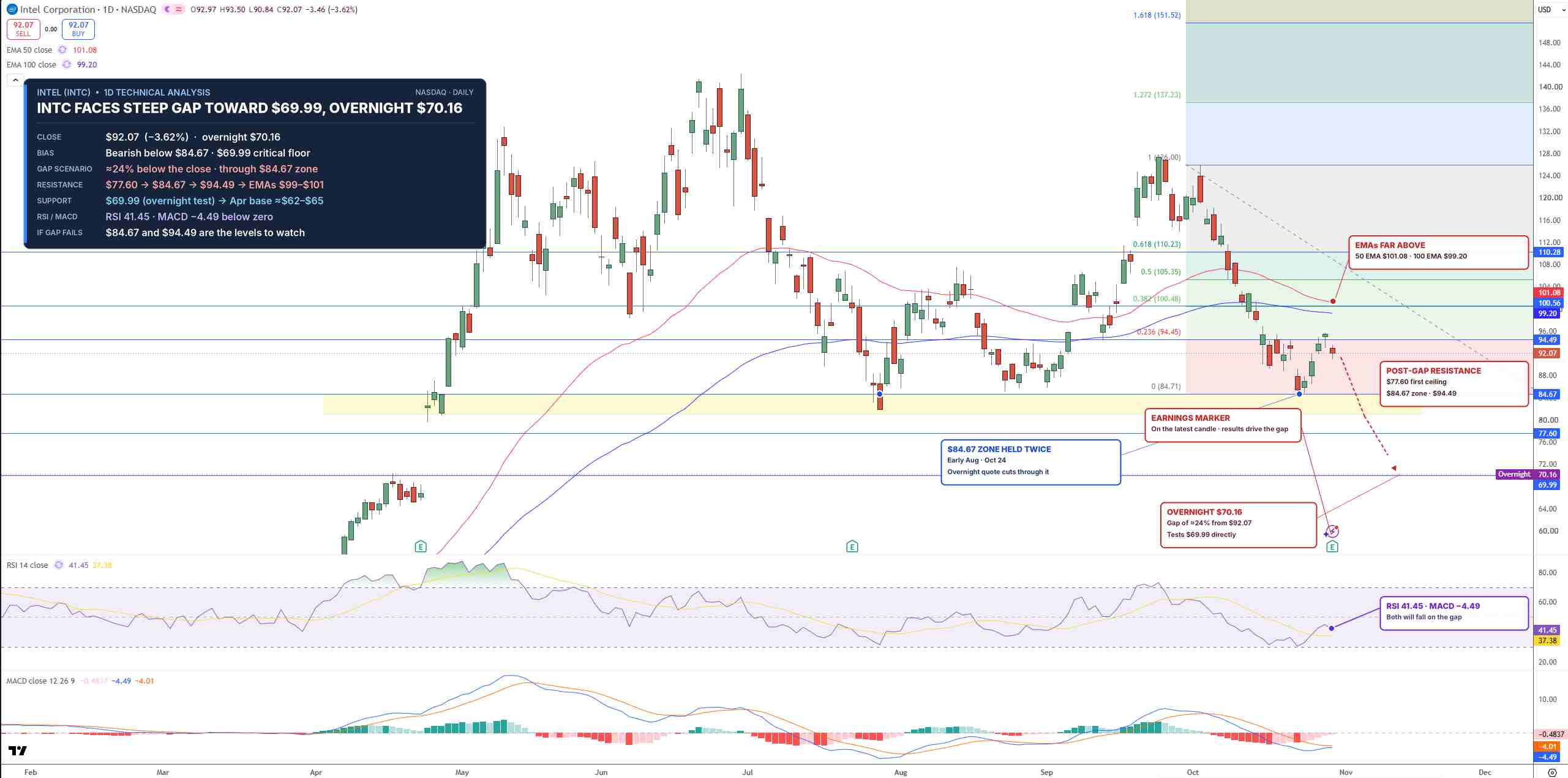
INTC Price Chart - Source: Tradingview
The overnight price is sitting right on $69.99 support, and a daily close below it would open the way for further losses. For buyers, a move back above $77.60 would be the first sign of relief. The bigger hurdle is $84.67, because broken support often turns into resistance.
I'm bearish while INTC stays below $84.67, and $69.99 is the floor that matters most.
Key Levels
- Last close: $92.07, down 3.62% on October 29 (overnight: $70.16)
- Support: $69.99
- Resistance: $77.60, $84.67, $99.20, $101.08
- RSI: 41.45 at Thursday's close, before the overnight drop
- Bullish trigger: Daily close above $84.67
- Bearish trigger: Daily close below $69.99
FAQs
Why did Intel stock fall after earnings?
Intel dropped about 24% overnight because its Q4 guide of $15.0 billion to $16.0 billion in revenue and $0.25 in adjusted EPS fell far below estimates, as a memory-driven PC slump and the Israel factory shutdown weigh on sales.
What is the Intel stock forecast now?
The bias is bearish below $84.67 on the daily chart. A daily close below $69.99 would open further downside, while a move back above $77.60 would be the first sign of relief.
Bottom Line
Intel's data center business is growing at its fastest pace in 15 years, but the PC slump and Israel shutdown make Q4 much weaker. The level that matters is $69.99, which the overnight price is testing. In my view, a daily close below it extends the selloff, and only a move back above $84.67 would change the bearish picture.
Nothing in this material constitutes investment advice, personal recommendation, investment research, an offer, or a solicitation to buy or sell any financial instrument. The content has been prepared without consideration of your individual investment objectives, financial situation, or needs, and should not be treated as such.
Past performance is not a reliable indicator of future performance and/or results. Forward-looking scenarios or forecasts are not a guarantee of future performance. Actual results may differ materially from those anticipated.
Mitrade makes no representation or warranty as to the accuracy or completeness of the information provided and accepts no liability for any loss arising from reliance on such information.
Recommended Articles


