


Dollar Index Hits Near 19-Month High Above 103 as Fed Rate Hike Bets Heat Up, USD/JPY Nears 160
TradingKey - On November 12, the US Dollar Index extended its recent upward trend during Asian trading hours, briefly breaking through the 103 mark intraday to reach a high of 103.08, hitting a near-19-month high since April 2025. With US October inflation data coming in higher than market expectations and Federal Reserve officials continuously delivering hawkish signals recently, the market further raised expectations for a December rate hike, lending support to the sustained strength of the US dollar.
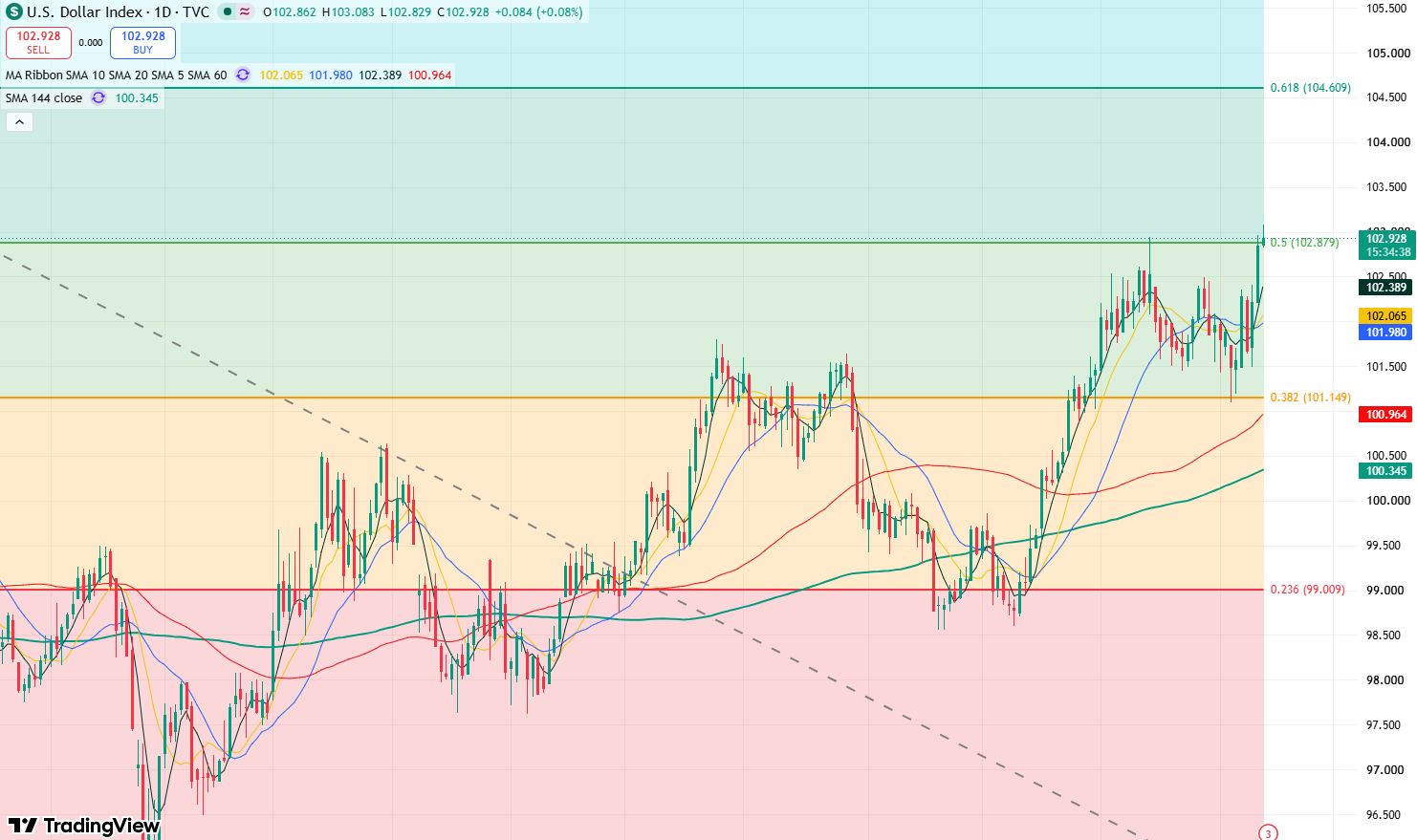
US Dollar Index daily chart, source: TradingView
As of press time, major non-US currencies were broadly under pressure. The euro fell about 0.08% against the US dollar to $1.1080, hitting a new low since May 2025; the British pound dropped about 0.16% against the US dollar to $1.3259. The US dollar against the Japanese yen (USDJPY) climbed to a more than two-month high intraday, reaching as high as 159.95 and approaching the key psychological level of 160.
Higher-than-expected US inflation has been an important driver behind this round of dollar gains. Data released by the US Bureau of Labor Statistics showed that the October Consumer Price Index (CPI) rose 0.4% month-over-month, higher than the market expectation of 0.3%; the core CPI, which excludes food and energy, rose 0.3% month-over-month, also exceeding the expected 0.2%. Persistent inflationary pressures have prompted investors to reassess the Federal Reserve's future interest rate path.
Meanwhile, Federal Reserve officials have recently sent clearer tightening signals. Fed Governor Waller stated that even if inflation eases somewhat, he still supports a 25-basis-point rate hike in December; if core inflation worsens further, a 50-basis-point rate hike should be considered in one go. According to the CME FedWatch Tool, the market-implied probability of a 25-basis-point rate hike by the Fed in December has risen to 90.8%, significantly higher than the 70% seen a month ago.
Some Wall Street institutions have also raised their expectations for future rate hikes. Among them, Goldman Sachs expects the Federal Reserve to raise rates in December this year and March next year, respectively, while Deutsche Bank anticipates that rate hikes could occur in December, January next year, and March.
In the short term, whether it can hold firmly above the 103 level will be a crucial condition for the US Dollar Index to sustain its upward momentum. Looking ahead, the market will closely monitor remarks by New York Fed President Williams, Friday's upcoming release of October PPI data, and the impact of subsequent US economic data on rate hike expectations. If the Federal Reserve continues to send hawkish signals, the US dollar may remain strong; conversely, if the market scales back rate hike expectations, the US Dollar Index may face pullback pressure.
Nothing in this material constitutes investment advice, personal recommendation, investment research, an offer, or a solicitation to buy or sell any financial instrument. The content has been prepared without consideration of your individual investment objectives, financial situation, or needs, and should not be treated as such.
Past performance is not a reliable indicator of future performance and/or results. Forward-looking scenarios or forecasts are not a guarantee of future performance. Actual results may differ materially from those anticipated.
Mitrade makes no representation or warranty as to the accuracy or completeness of the information provided and accepts no liability for any loss arising from reliance on such information.
Recommended Articles


