



Gold falls below $4,000 as traders weigh a half-point Fed rate hike
- Gold struggles to attract buyers as hawkish Fed expectations continue to dominate market sentiment.
- Stronger US inflation and hawkish Fed remarks lead markets to fully price in a December rate hike.
- XAU/USD maintains a bearish bias below the 20-day SMA, while the RSI near 41 points to weak buying momentum.
Gold (XAU/USD) slips back below $4,000 on Thursday, giving up most of last week’s gains as bets on more aggressive Federal Reserve (Fed) interest rate hikes lift the US Dollar (USD) to a fresh year-to-date high. The Greenback has since pulled back, helping Gold recover from its intraday low of $3,924. At the time of writing, XAU/USD trades around $3,952, down 0.82% on the day.
The US Dollar Index (DXY), which tracks the Greenback against a basket of six major currencies, trades near 102.88, off its high of 103.08.
Fed Governor Christopher Waller put a 50-basis-point (bps) hike in December on traders’ radar before Tuesday’s US inflation report. Waller said a half-point hike could be needed if October core Consumer Price Index (CPI) came in “around 0.3% or higher.” And that’s what happened. Core CPI rose 0.3% on the month, above the 0.2% forecast, while headline CPI rose 0.4%, beating the 0.3% estimate.
Dollar momentum builds as markets fully price in December Fed hike
Analysts at MUFG/BTMU note that "there are currently around 28bps of hikes priced by December, and 43bps of hikes priced by the following meeting in January," which "indicat[es] that even if the Fed hikes by 25bps in December, it is now expected to quickly follow up with another 25bps hike at the start of next year."
ING strategists add that "the combination of hawkish Fedspeak and a US CPI beat earlier this week continues to pay dividends for the Dollar," with DXY now "back at Liberation Day (April 2025) levels." They stress that "real front-end rate differentials [are] continuing to fuel strong Dollar momentum" and that "this remains a rates-driven move, with contained excessive USD strength relative to short-term fair value currently built in."
The prospect of higher borrowing costs takes some shine off Gold as investors favour assets that pay interest. Traders now turn to upcoming US economic data, including weekly jobless claims later on Thursday and the Producer Price Index (PPI) due on Friday, with several Fed officials also set to speak over the rest of the week.
US-Iran developments are also in focus. The Wall Street Journal (WSJ) reported that US Vice President JD Vance is weighing face-to-face talks with senior Iranian security official Mohsen Rezaei. The discussions are still preliminary, and no date has been set. Signs of progress toward a deal could keep Oil prices under pressure. A sustained drop in Oil prices could ease inflation pressures and prompt traders to dial back bets on more aggressive Fed rate hikes.
Technical analysis:
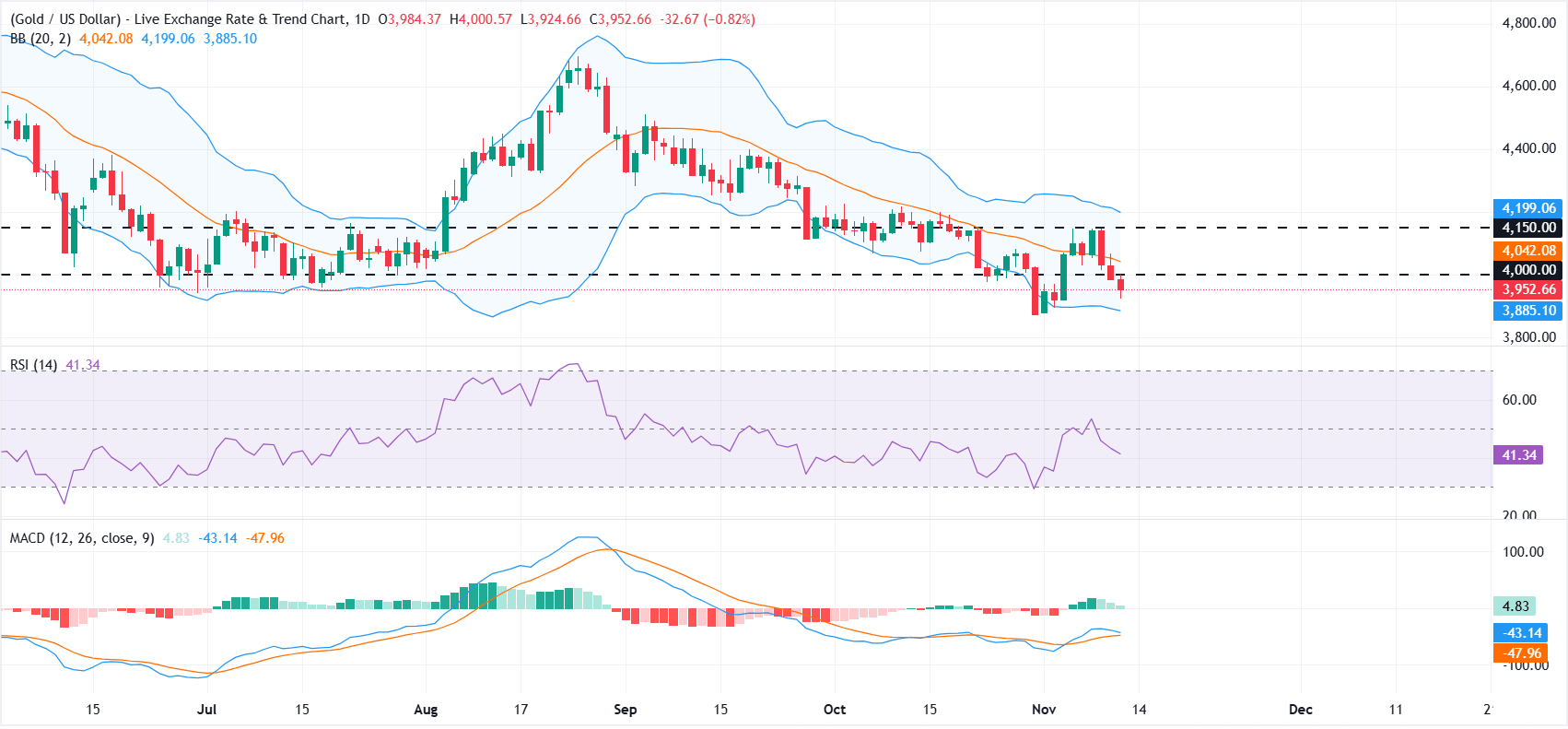
On the daily chart, XAU/USD keeps a bearish tone as it sits beneath the 20-day Simple Moving Average (SMA) of the Bollinger Bands at $4,042. Momentum is relatively subdued, with the 14-day Relative Strength Index (RSI) hovering around 41, suggesting only modest buying interest despite a mildly positive Moving Average Convergence Divergence (MACD) reading above zero.
On the topside, initial resistance is seen at $4,000, followed by the mid-Bollinger 20-day SMA at $4,042. A sustained break above these levels would open the way toward $4,150 and the Bollinger upper band at roughly $4,199. On the downside, immediate support emerges at the lower Bollinger band near $3,885, with any decisive move below that zone likely to reinforce the prevailing bearish bias and expose deeper retracement levels.
(The technical analysis of this story was written with the help of an AI tool. Know more.)
Gold FAQs
Gold has played a key role in human’s history as it has been widely used as a store of value and medium of exchange. Currently, apart from its shine and usage for jewelry, the precious metal is widely seen as a safe-haven asset, meaning that it is considered a good investment during turbulent times. Gold is also widely seen as a hedge against inflation and against depreciating currencies as it doesn’t rely on any specific issuer or government.
Central banks are the biggest Gold holders. In their aim to support their currencies in turbulent times, central banks tend to diversify their reserves and buy Gold to improve the perceived strength of the economy and the currency. High Gold reserves can be a source of trust for a country’s solvency. Central banks added 1,136 tonnes of Gold worth around $70 billion to their reserves in 2022, according to data from the World Gold Council. This is the highest yearly purchase since records began. Central banks from emerging economies such as China, India and Turkey are quickly increasing their Gold reserves.
Gold has an inverse correlation with the US Dollar and US Treasuries, which are both major reserve and safe-haven assets. When the Dollar depreciates, Gold tends to rise, enabling investors and central banks to diversify their assets in turbulent times. Gold is also inversely correlated with risk assets. A rally in the stock market tends to weaken Gold price, while sell-offs in riskier markets tend to favor the precious metal.
The price can move due to a wide range of factors. Geopolitical instability or fears of a deep recession can quickly make Gold price escalate due to its safe-haven status. As a yield-less asset, Gold tends to rise with lower interest rates, while higher cost of money usually weighs down on the yellow metal. Still, most moves depend on how the US Dollar (USD) behaves as the asset is priced in dollars (XAU/USD). A strong Dollar tends to keep the price of Gold controlled, whereas a weaker Dollar is likely to push Gold prices up.
Nothing in this material constitutes investment advice, personal recommendation, investment research, an offer, or a solicitation to buy or sell any financial instrument. The content has been prepared without consideration of your individual investment objectives, financial situation, or needs, and should not be treated as such.
Past performance is not a reliable indicator of future performance and/or results. Forward-looking scenarios or forecasts are not a guarantee of future performance. Actual results may differ materially from those anticipated.
Mitrade makes no representation or warranty as to the accuracy or completeness of the information provided and accepts no liability for any loss arising from reliance on such information.
Recommended Articles


