



SanDisk Stock Price Forecast: Oversold Rebound Drives 14% Rally, Break Above $1,000 Could Spark Another 14% Gain
TradingKey - SanDisk (SNDK) shares rose 13.7% on Wednesday to close at around $983. Although the stock remains well below its year-to-date high, Evercore ISI analyst Amit Daryanani believes the current pullback does not suggest that the growth thesis has reversed, setting a price target of $2,500.
This optimistic assessment primarily stems from structural shifts currently unfolding across the NAND flash memory industry. Historically, memory chipmakers maintained high production levels even as market demand softened in an effort to absorb steep fixed costs. This practice routinely triggered inventory gluts, oversupply, and falling prices, generating pronounced cyclical swings in industry profitability. Today, major manufacturers are progressively shifting their operating strategies toward demand-driven production rather than relying strictly on capacity expansion to reduce per-unit costs, which could lower the likelihood of a renewed price war.
SanDisk management noted in recent discussions that the company is not currently facing severe supply constraints. Given that its existing operations already enjoy strong profitability, the company lacks the incentive to pursue aggressive capacity expansion. Daryanani believes that more disciplined supply behavior could prolong the period over which NAND prices and profit margins remain elevated, rendering SanDisk's earnings performance more stable than in previous cycles.
Evolving customer procurement practices are also bolstering revenue visibility. Conventional NAND purchase orders were predominantly renegotiated on a quarterly basis, leaving prices vulnerable to swift swings driven by inventory shifts and market sentiment. As artificial intelligence data centers drive continued demand growth for high-capacity storage, an increasing number of customers are pursuing multi-year partnerships and securing supply through minimum purchase volumes, demand commitments, and financial guarantees. A higher proportion of long-term agreements helps SanDisk insulate its financial performance from short-term price fluctuations.
At the same time, NAND procurement by major cloud computing hyperscalers is shifting from forward-looking planning toward immediate deployment. As AI model parameters expand and inference workloads generate rising volumes of data, data centers require not only more compute chips, but also higher-capacity, lower-power storage devices. Certain customers have already requested that NAND products be integrated directly into server racks, indicating that actual demand is accelerating into deployment rather than remaining in the capital expenditure commitment phase.
Daryanani believes the market remains overly focused on how much longer NAND prices can be sustained, without adequately pricing in the business-model transformation driven by supply discipline, long-term procurement agreements, and AI-related storage demand. For SanDisk, the decisive factor in whether the stock can march toward the $2,500 target is not the scale of its short-term rebound, but whether high profit margins can persist and data center orders can reliably convert into steady cash flow.
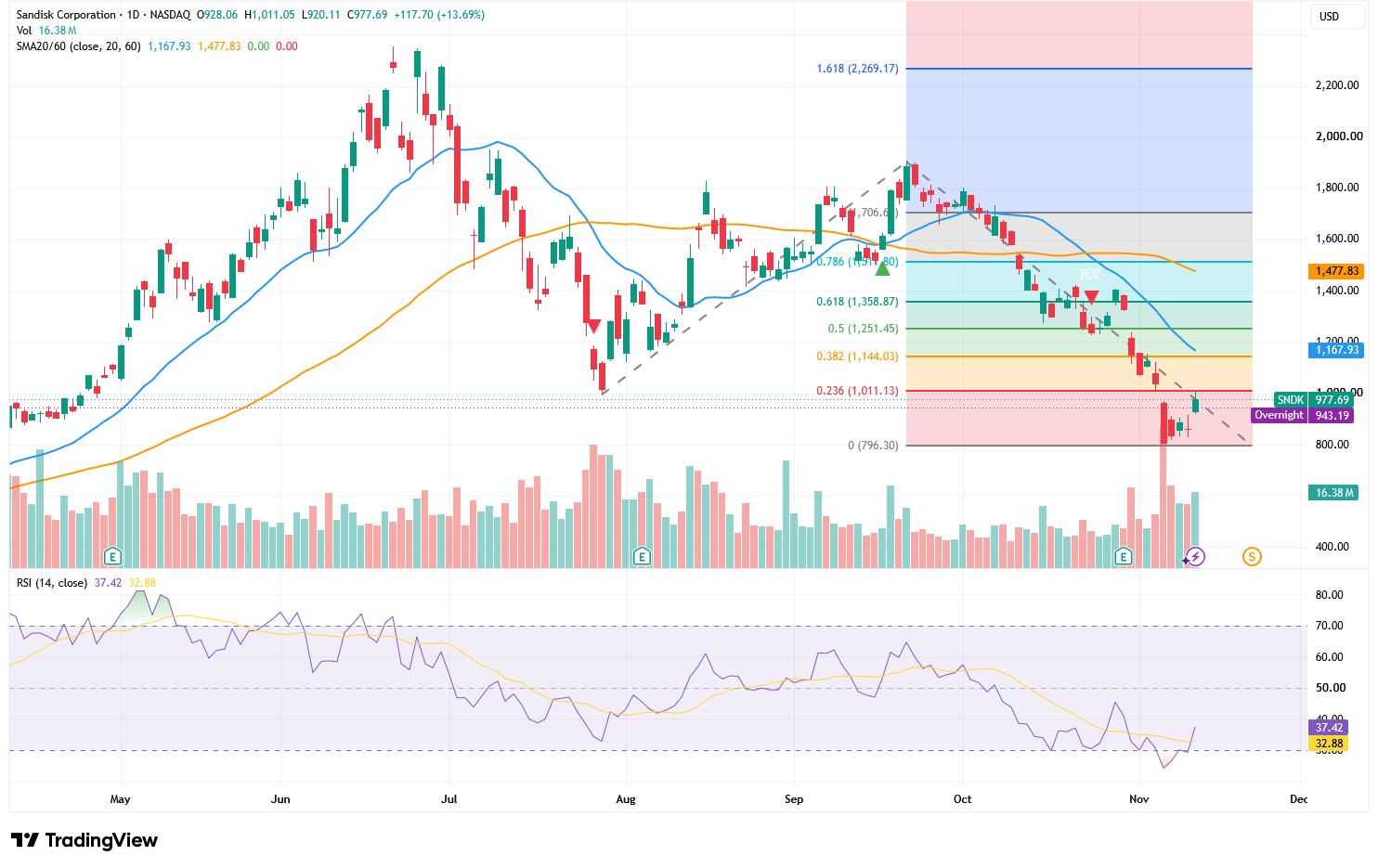
Source: TradingView
Although buying momentum briefly propelled the stock above $1,000, it failed to hold this psychological round-number threshold into the close, indicating that short-term selling pressure has not fully abated. Looking ahead, whether $1,000 can transition from resistance into support will serve as a crucial gauge for the sustainability of this rebound.
SanDisk had previously been in a sustained decline from its year-to-date high, logging a cumulative drawdown of nearly 60% and recently probing levels near $800. Following this sharp correction, valuation pressures have eased somewhat, and capital has begun flowing back into oversold names amid a broader recovery across the memory chip sector. Nonetheless, the single-day surge resembles a technical rebound and remains insufficient to confirm that the medium-term trend has reversed.
The 23.6% Fibonacci retracement level sits at $1,011.13. If SanDisk can subsequently break through this barrier on heavy volume and achieve consecutive closes above it, the stock could advance toward the 38.2% retracement level at $1,144, representing potential upside of approximately 14% from $1,000.
The $1,144 to $1,168 band will form a stronger resistance zone, with $1,167.93 aligning closely with the 20-day moving average. The stock must overcome this zone to alter its short-term downward trajectory. Should buying momentum build further, subsequent targets emerge at $1,251 and $1,359; however, until the 20-day moving average is reclaimed, the foundation for an outright resumption of the medium-term uptrend remains incomplete.
Momentum indicators are showing early signs of recovery: the 14-day RSI has bounced from oversold territory to 37.42 and reclaimed its smoothed signal line at 32.88, pointing to waning bearish momentum. However, because the RSI remains below 50, sellers have not fully surrendered control. If the RSI continues to approach 50 while the stock establishes firm support above $1,011, the validity of this upward move will be substantially strengthened.
To the downside, short-term support near $943 warrants initial attention. If the stock holds this level through pullbacks, the market may retest the $1,000 to $1,011 zone; a breakdown below $943 would cast doubt on the strength of the rebound, leaving $900 as the next potential defense line. Should $900 also fail to hold, the stock cannot rule out a retest of its interim low near $800.
Nothing in this material constitutes investment advice, personal recommendation, investment research, an offer, or a solicitation to buy or sell any financial instrument. The content has been prepared without consideration of your individual investment objectives, financial situation, or needs, and should not be treated as such.
Past performance is not a reliable indicator of future performance and/or results. Forward-looking scenarios or forecasts are not a guarantee of future performance. Actual results may differ materially from those anticipated.
Mitrade makes no representation or warranty as to the accuracy or completeness of the information provided and accepts no liability for any loss arising from reliance on such information.
Recommended Articles


