



【US Pre-Market】Nvidia Falls Over 7% as Board Reportedly Discusses Jensen Huang's Future, Memory Stocks Under Pressure, SanDisk Drops Over 5%, Gold Falls Below $4,000
TradingKey - On November 12, Eastern Time, futures on the three major U.S. stock indices were mixed, with tech stocks coming under pressure once again. As of press time, Nasdaq 100 Index futures fell about 0.9%, S&P 500 Index futures dropped about 0.42%, and Dow futures were virtually flat.
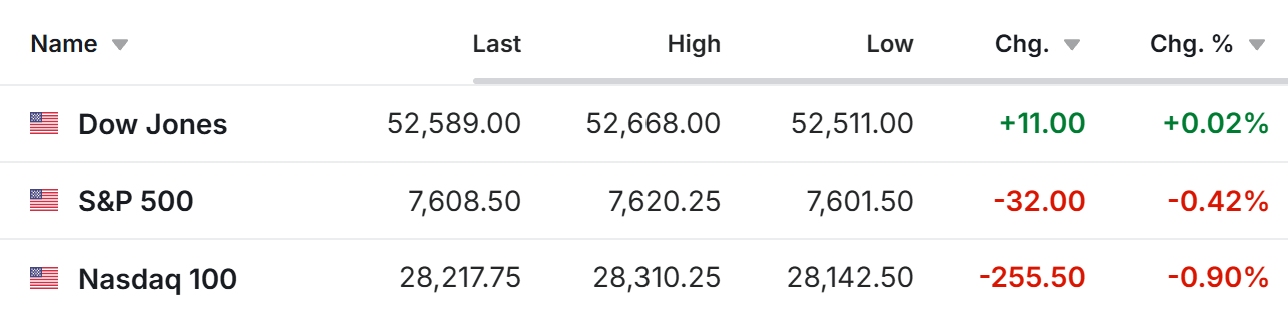
[Source: Investing]
A day earlier, AI and semiconductor stocks rebounded, with the Nasdaq Composite Index rising 1.6%, the S&P 500 climbing 1.3%, and the Dow advancing 0.5%. CoreWeave (CRWV) delivered better-than-expected third-quarter results, driving AI cloud computing and chip stocks higher.
However, after the U.S. market close, The Wall Street Journal reported that Nvidia's (NVDA) board of directors was considering arrangements for Jensen Huang's CEO role, sending Nvidia shares down about 8% in after-hours trading and reigniting market concerns over the company's management stability.
In commodities, international oil prices edged lower. As of press time, Brent crude (UKOIL) was at $90.85 per barrel, and WTI crude (USOIL) stood at $85.01 per barrel. The situation in the Middle East and shipping risks in the Strait of Hormuz remain key factors influencing energy prices.
Gold (XAUUSD) broke below the $4,000 threshold, currently trading at $3,943.5 per ounce; Bitcoin (BTCUSD) was trading near $73,000.
Market Movers
Nvidia fell over 7% premarket as its board reportedly discussed Jensen Huang's future.
Nvidia fell about 7% in premarket trading. According to The Wall Street Journal, the company's board of directors is preparing to remove CEO Jensen Huang and has discussed his future. Reuters and other media outlets also followed up on the news, but as of press time, Nvidia has not officially announced a CEO change.
Previously, Nvidia's board hired outside counsel to conduct an independent investigation into whether Jensen Huang had been targeted by a foreign intelligence operation and whether related ties involved company information security. The board previously stated there was no reason to believe that company trade secrets or U.S. national security were compromised.
Uncertainty over management changes has prompted investors to reassess Nvidia's corporate governance, customer relationships, and future operational plans.
AI chip stocks diverged as memory chip stocks fell, while AMD (AMD) and Broadcom (AVGO) showed relative strength.
As Nvidia came under pressure, Micron (MU), SanDisk (SNDK), and SK Hynix (SKHY), among other memory chip stocks, fell year-over-year, while AMD and Broadcom remained relatively resilient premarket. As of press time, Micron was down over 3%, SK Hynix and SanDisk were down over 4%, while AMD was up 2.25% and Broadcom was up 1%.
The market has begun to focus on the potential impact of Nvidia's management uncertainty on other AI chip suppliers.
However, switching chip suppliers still involves product performance, software ecosystems, supply capacity, and qualification processes; market share will not shift immediately due to a single management event.
CoreWeave fell about 7% premarket and plans to issue at least $4 billion in investment-grade loans.
CoreWeave reportedly plans to raise at least $4 billion in investment-grade loans to purchase Nvidia GPUs and other computing equipment to fulfill customer contracts. The financing interest rate is expected to be 7% to 7.5%, lower than yields of over 15% on some of the company's unsecured bonds. While this financing is expected to lower borrowing costs, the company's debt and capital expenditure pressures remain in focus.
Nebius (NBIS) fell over 8% at one point premarket, with third-quarter revenue up 571% and capital expenditures rising to $7.3 billion.
Nebius's third-quarter revenue grew 571% year-over-year to $980.8 million, with adjusted EBITDA reaching $465.8 million and adjusted net income at $90.9 million. However, the company still recorded a net loss from continuing operations of $37.5 million.
Third-quarter capital expenditures reached $7.3 billion, up approximately 664% year-over-year, reflecting the company's aggressive expansion in AI data center construction. Investors will focus on whether revenue growth can be sustained and how heavy infrastructure spending will affect cash flow and financing needs.
Market News
Anthropic adds over $10 billion in cloud computing contract commitments with Microsoft and Google.
According to reports, Anthropic has entered into new cloud computing agreements with Microsoft (MSFT) and Google, with computing power procurement commitments exceeding $10 billion and contract terms extending through 2033. This move reflects the continued growth in demand for cloud computing resources for Claude model training and commercial services, while also increasing the company's long-term computing expenditures.
Union at Micron's Taiwan Taoyuan plant withdraws from profit-sharing negotiations as bonus distribution dispute continues.
The union at Micron's Taoyuan plant announced on November 12 that its efforts to establish a long-term profit-sharing mechanism had been unsuccessful, and it decided not to participate in the follow-up negotiations originally scheduled for November 17. The union had previously demanded that 15% of the company's profits be allocated to employee compensation.
Micron stated that it respects employees' rights to organize unions and engage in collective bargaining, and remains willing to maintain communication with the Taoyuan union. Disagreements between the two sides center primarily on the profit-sharing ratio and employee bonus arrangements, and the outlook for labor relations remains to be seen.
Kioxia and Dell launch 157PB single-rack all-flash storage solution.
Kioxia and Dell (DELL) have launched an all-flash storage solution with a single-rack capacity of up to 157PB, equipped with 640 245.76TB SSDs, primarily targeting AI training, data analytics, and cloud computing. The solution is designed to increase storage density and reduce data center space and power consumption requirements. The 157PB figure represents raw capacity, not actual usable capacity.
MSCI evaluates index eligibility for digital asset treasury companies, with MicroStrategy facing potential adjustment risks.
MSCI is evaluating whether to adjust index inclusion rules for digital asset treasury companies, which could affect firms holding large amounts of bitcoin such as MicroStrategy (MSTR).
If the affected companies are excluded from certain indexes in the future, passive funds tracking those indexes could adjust their holdings, increasing selling pressure on their shares. However, the specific scope of the adjustments and implementation arrangements remain subject to MSCI's final decision.
Key Events Preview
Eastern Time | Event |
Nov. 12, 8:30 AM | US Initial Jobless Claims for the week ended Nov. 7 |
Nov. 12, 10:00 AM | US October Existing Home Sales (Annualized) |
Nov. 12 Post-Market | Cisco (CSCO), Applied Materials (AMAT), Cerebras (CBRS), Virgin Galactic (SPCE) report earnings |
Nothing in this material constitutes investment advice, personal recommendation, investment research, an offer, or a solicitation to buy or sell any financial instrument. The content has been prepared without consideration of your individual investment objectives, financial situation, or needs, and should not be treated as such.
Past performance is not a reliable indicator of future performance and/or results. Forward-looking scenarios or forecasts are not a guarantee of future performance. Actual results may differ materially from those anticipated.
Mitrade makes no representation or warranty as to the accuracy or completeness of the information provided and accepts no liability for any loss arising from reliance on such information.
Recommended Articles


